Ecommerce marketing automation statistics
Where triggered messages deliver. What reliable automation requires.

Ecommerce marketing automation depends on eligible customer events, current product data and content ready for the placement. Direct maturity research and lifecycle benchmarks describe different parts of that workflow.
Key takeaways
Start with useful customer events. Cart and welcome flows accounted for 76% of automated-email orders in the selected 2025 platform benchmark. [1]
Compare automation with the right denominator. Automated messages were 2% of email sends but received 30% of attributed email revenue in that dataset. [1]
A reliable trigger needs reliable data. Quality-data collection was a challenge for 52% of decision makers in Ascend2's historical 2024 automation survey. [9]
Key facts at a glance
Email sends from automation
2%of email sends were automated.
2025; selected platform email sends
OmnisendAttributed email revenue from automation
30%of email-attributed revenue came from automation.
2025; vendor-attributed email revenue
OmnisendWelcome-email revenue per recipient
$5.75was average email welcome-flow revenue per recipient.
2026 edition; selected welcome flows
KlaviyoRespondents with fully automated journeys
9%of Ascend2 respondents described their overall customer journey as fully automated.
Feb 2024; 387 mixed B2B/B2C decision makers
Ascend2 and Research PartnersRespondents reporting data-quality challenges
52%identified collecting quality data as a marketing-automation challenge.
Feb 2024; self-reported automation challenge
Ascend2 and Research PartnersSubscription renewals processed automatically
71.5%of due subscription renewals processed automatically.
2025 activity; selected subscription renewals
Recharge
Automation revenue and order mix
2% of email sends were automated. [1]
Observed 2025 platform activity.
30% of email-attributed revenue came from automation. [1]
Attribution is not incrementality.
$2.87 was revenue per automated email, versus $0.18 for campaigns. [1]
Different audiences limit direct comparison.
76% of automated-email orders came from cart and welcome flows. [1]
Order concentration depends on flow coverage.
6.46% was the back-in-stock email conversion rate. [1]
High-intent recipients shape this result.
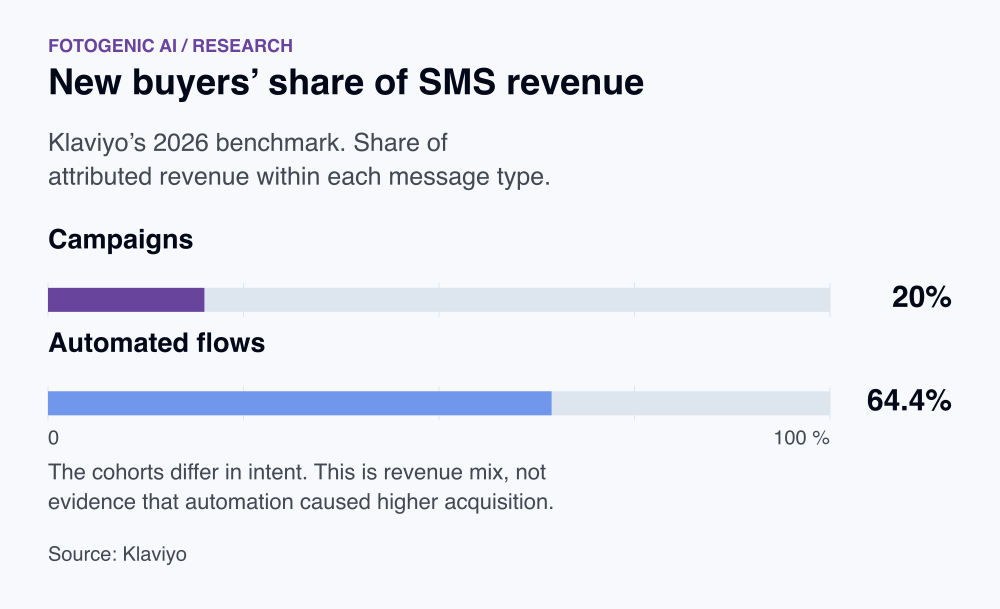
20% of SMS campaign revenue came from new buyers. [2]
A revenue-mix measure, not an acquisition conversion rate.
64.4% of SMS flow revenue came from new buyers. [2]
Behavior-triggered audiences differ from broad campaigns; no causal lift is established.
Flow-specific benchmarks
$5.75 was average email welcome-flow revenue per recipient. [3]
Vendor-attributed revenue for new-subscriber flows, not the incremental value of automation.
$2.08 was average email browse-abandonment revenue per recipient. [3]
A different trigger and audience from welcome and cart flows. Compare within flow type.
Renewals and AI automation
71.5% of due subscription renewals processed automatically. [4]
Trailing twelve months through May 2026. Operational automation, separate from marketing attribution.
34.70% of AI-using EU enterprises applied AI to marketing or sales. [5]
2025 survey; denominator is enterprises already using AI, not all businesses. Includes more than marketing messaging.
3.0% relative purchase-conversion lift followed AI marketing push messages in a retail experiment. [6]
Working-paper result; the corresponding 1.6% sales change was not statistically significant. Push messages are not SMS and this is not an Omnisend replication.
Adoption and message eligibility
75% of Salesforce-surveyed marketers reported using AI. [7]
Cross-industry 2025 survey published in 2026. AI use is broader than marketing automation and does not show every flow is deployed or effective.
81% of Attentive-surveyed messaging subscribers said a back-in-stock alert made them more likely to purchase. [8]
Stated likelihood in the February 2026 subscriber sample, not observed conversion or an experiment. Availability must be verified before sending.
Direct automation maturity and data challenges
9% of Ascend2 respondents described their overall customer journey as fully automated. [9]
February 2024 survey of 387 marketing decision makers, not a 2026 ecommerce adoption rate. Fully automated does not mean more effective.
59% described their customer journey as partially automated in that survey. [9]
Historical mixed B2B/B2C population. Maturity is self-reported; this does not imply partial automation is a defect.
52% identified collecting quality data as a marketing-automation challenge. [9]
Nonexclusive responses from the same February 2024 survey; integrating technologies/data was also a stated challenge, at 40%.
Turn customer records into eligible events
A CRM record stores customer information; it does not define when a message should run. For each flow, name the event, required data, channel eligibility and owner of the decision. Use an observed customer action rather than treating every stored contact as an eligible recipient.
Compare automated messages with the audience they can actually reach. A recent signup, cart or stock request selects a different cohort from a general campaign list. Higher attributed return per message does not isolate the effect of automation.
Feed approved product assets into the creative workflow: review the bulk image-production workflow.
Map the trigger, suppression and fallback
Use this operating map to brief a flow before producing its creative. It describes checks to implement in your messaging system, rather than capabilities guaranteed by every provider.
| Flow and customer event | Send-time requirement | Suppression or fallback |
|---|---|---|
| Garment restock alert | Exact size/color is purchasable and the subscriber requested the alert | Suppress if purchased, unavailable or permission withdrawn |
| First-order product-care email | Fulfilled item and approved care instructions | Route unresolved delivery or return cases to service |
| Seasonal collection message | Eligible audience, current destination and matching imagery | Use the approved general collection when individual context is missing |
Separate creative production from message delivery: define a consistent catalogue brief.
Validate the message at send time
After any delay, check the current order, offer, inventory and recipient status again. Assign an owner for missing records and rejected sends. Exercise the eligible, purchased, unavailable-product and missing-data paths, then inspect the final message and destination together.
Subscriber interest in stock alerts supports testing a useful notification; it does not predict its conversion rate. Measure delivered messages, qualifying orders and opt-outs for the eligible cohort. Organization-level AI adoption does not establish that a particular flow works reliably.
The bulk product image generator addresses visual production at scale. Marketing triggers and suppression remain in your messaging system.
Prepare creative before enabling the flow
Keep the image asset, exact variant and destination together in the production record. Give the messaging platform an approved file for the required placement, then check the final mobile message and linked page. Visual production and event orchestration remain separate jobs.
A restock trigger can be valid when queued and false at send time. Recheck stock and completed orders before sending. If the garment has sold out, suppress the specific alert rather than displaying a substitute image under the original promise.
FAQ
Questions about the research
Omnisend’s 2025 data attributed 76% of automated-email orders to cart and welcome flows. That makes those triggers useful candidates, alongside back-in-stock where availability is reliable. Choose the next flow using eligible reach, observed incremental contribution and maintenance cost. A high vendor-attributed revenue per message does not by itself establish the best investment for a store.
Sources and method
- Omnisend: 2026 ecommerce marketing report
omnisend.com
ReturnStudy details
2025 activity
150,000 brands. Platform attribution; automated and campaign audiences differ.
- Klaviyo: 2026 SMS marketing benchmarks
klaviyo.com
ReturnStudy details
2026 benchmark edition
Klaviyo customer messaging activity. Public summary does not expose the exact eligible SMS cohort or observation window. Flows and campaigns have different intent and attribution; results are observational.
- Klaviyo: The abandoned cart benchmarks report: 2026 data to inform your strategy
klaviyo.com
ReturnStudy details
October 2, 2026 publication
Analysis of more than 110,000 Klaviyo customers across industries. Average and top-decile brand flow metrics are distinct. Public article does not specify exact collection dates, per-flow sample counts or attribution windows. Revenue per recipient is vendor-attributed revenue, not incremental recovery or profit.
- Recharge: Subscription renewals and the 2023 subscriber cohort
getrecharge.com
ReturnStudy details
2023 cohort and 2023-2025 revenue; updated August 2026
Platform analysis of more than 20,000 subscription brands. Order-sequence retention differs from calendar-month retention; revenue excludes tax. Not a benchmark for all ecommerce stores.
- Eurostat: AI use by enterprise size and purpose
ec.europa.eu
ReturnStudy details
2025 enterprise survey
Covered EU sectors with at least ten workers. Small: 10-49; medium: 50-249; large: 250+. All AI, not ecommerce-only or generative-image-only. Marketing-purpose percentage uses AI-using enterprises as denominator.
- Cui and coauthors / arXiv: Generative AI and Firm Productivity: Field Experiments in Online Retail
arxiv.org
ReturnStudy details
October 2025 working paper, version 1
Randomized workflows at one cross-border platform. Effects are relative to workflow-specific controls. The study is a preprint and does not test product-image generation. Support control offered no presale assistance; message sales effect was not statistically significant.
- Salesforce: State of Marketing 2026
salesforce.com
ReturnStudy details
October 8-November 17, 2025 survey; February 19, 2026 release
Double-anonymous survey of 4,450 marketing decision makers across North America, Latin America, Asia-Pacific and Europe. Marketer perceptions, not consumer behavior or an ecommerce-only census. Performance categories describe satisfaction with marketing outcomes.
- Attentive: 2026 personalization and subscriber expectations
attentive.com
ReturnStudy details
February 23, 2026 consumer survey; September article update
Pollfish online survey of 1,050 US, UK and Australian consumers aged 18-79, who shopped online in the previous three months and opted into at least email or text marketing. Four generations contribute equally, with no other post-stratification. Questions span messaging channels, not SMS alone. Separate April consumer and marketer data on the page are not combined with these findings.
- Ascend2 and Research Partners: The State of Marketing Automation 2024
ascend2.com
ReturnStudy details
February 2024 survey; March 2024 publication
Online panel and research-subscriber survey of 387 marketing decision makers: 46% B2C, 21% B2B and 33% both. Historical self-reported use and maturity, not a 2026 ecommerce adoption census. Current-use chart is page 9; customer-journey maturity page 10; challenges page 8. Responses are not observed automation ROI.
How this report uses research
This report is an editorial synthesis by Fotogenic AI, updated on October 19, 2026. Source dates describe the underlying evidence. Survey responses, measured activity and forecasts are identified separately. Findings are not combined into a new market average. Multiple pages describing one study are treated as one evidence family.
Create with Fotogenic AI
Prepare visuals for your lifecycle messages
Create product images in Fotogenic AI for the garment, offer and destination in your flow. Hand the reviewed assets to the marketing platform that manages the message.