SMS marketing statistics
What SMS benchmarks really measure. How to separate clicks from value.
SMS campaigns, automated flows and cart reminders reach different audiences and produce different measured outcomes. Compare clicks, orders and attributed revenue within the same message type; ordinary SMS does not provide a measured open rate.
Key takeaways
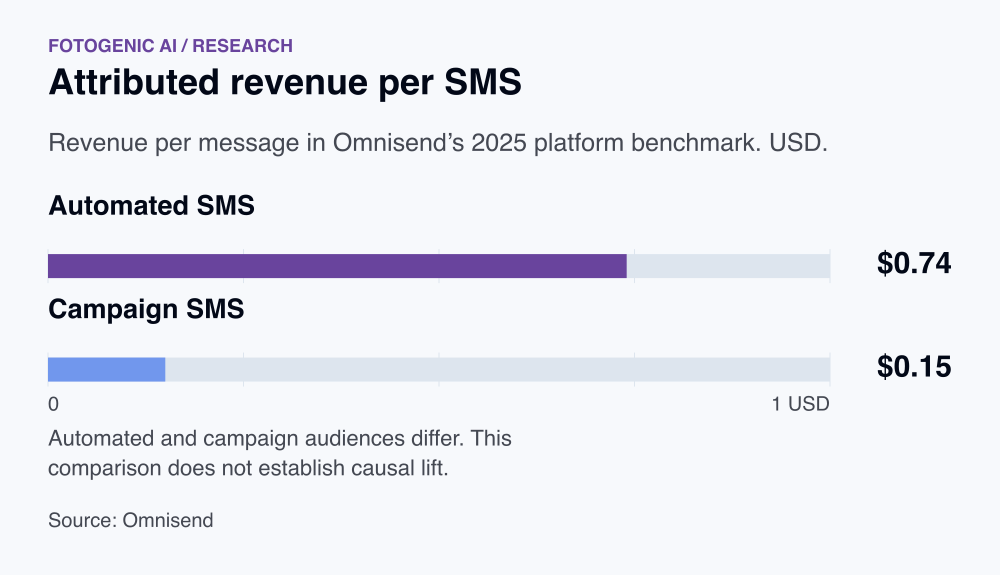
Separate triggered messages from broad campaigns. The 2025 benchmark attributed USD 0.74 per automated SMS and USD 0.15 per campaign SMS. [1]
Suppress reminders after an order. Among surveyed messaging subscribers, 67% said continued purchase reminders made them more likely to unsubscribe. [5]
Budget SMS by billable segments and applicable extras. Twilio's listed US long-code base fee was USD 0.0083 per segment before carrier charges. [7]
Key facts at a glance
Attributed revenue per automated SMS
$0.74was attributed revenue per automated SMS.
2025; vendor-attributed automation revenue
OmnisendAttributed revenue per campaign SMS
$0.15was attributed revenue per campaign SMS.
2025; vendor-attributed campaign revenue
OmnisendAbandoned-cart text click rate
10.3%was average click rate for text-message abandoned-cart flows.
2026 edition; selected text cart flows
KlaviyoUS SMS base price per segment
$0.0083was Twilio's listed US outbound long-code SMS base price per segment.
July 2026 tariff; base fee, extras excluded
TwilioCritical US campaign unsubscribe range
2.0%or higher was Klaviyo's critical campaign-unsubscribe diagnostic range for its US SMS/MMS guidance.
Oct 2025 guidance; US campaign diagnostic
Klaviyo Help CenterCampaign SMS click rate
5.6%was the campaign SMS click rate in Klaviyo’s 2026 FAQ benchmark.
2026 FAQ; selected vendor SMS campaigns
Klaviyo
Sending volume and attributed revenue
321M SMS messages were included in the 2025 benchmark. [1]
Platform cohort, not the whole SMS market.
40% growth in SMS sending volume was recorded. [1]
Volume growth is not revenue growth.
$0.74 was attributed revenue per automated SMS. [1]
Intent and attribution influence this comparison.
$0.15 was attributed revenue per campaign SMS. [1]
These are revenue figures before messaging costs.
Flows and customer mix
0.97% was the global SMS campaign click-to-conversion rate. [1]
Q4 bot-inflated clicks complicate interpretation.
7.6% of SMS sends were automated flows in Klaviyo’s benchmark. [2]
Platform activity, with a different customer cohort from the Omnisend figures.
45.2% of SMS-attributed revenue came from those flows. [2]
Revenue share is a different denominator from send share, not a conversion rate.
64.4% of SMS flow revenue came from new buyers. [2]
Attributed revenue mix, not the share of messages that acquired a customer.
Clicks and orders
5.6% was the campaign SMS click rate in Klaviyo’s 2026 FAQ benchmark. [3]
Click rate and click-to-order rate differ. Other Klaviyo guides publish different averages; keep this edition separate.
9.65% was the corresponding SMS-flow click rate. [3]
Triggered flows reach selected audiences. The difference is observational, not evidence that automating the same send causes this increase.
0.27% was the campaign SMS order rate in the same benchmark. [3]
Orders relative to message recipients, not the Omnisend click-to-conversion denominator.
1.9% was the corresponding SMS-flow order rate. [3]
Platform-attributed orders, with a conversion definition that differs from other provider benchmarks.
10.3% was average click rate for text-message abandoned-cart flows. [4]
Cart-triggered messages are a distinct subset. The broader SMS-flow benchmarks use different flow populations and editions.
Subscriber expectations and list health
65% of surveyed messaging subscribers were open to more frequent messages when relevant. [5]
February 2026 email-or-text subscriber sample, not an SMS-only frequency experiment. Stated willingness does not establish an optimal send cadence.
67% said continued reminders after purchasing made them more likely to unsubscribe. [5]
A stated response to messaging across channels, not an observed opt-out rate. The result supports purchase suppression, not a universal unsubscribe threshold.
List growth and frequency preferences
62% said a purchase made them more likely to subscribe to brand texts. [6]
Historical 2024 Klaviyo/Recharge survey of 8,781 frequent online shoppers. Stated likelihood, not an observed signup rate or marketing permission.
61% said receiving too many messages made them unsubscribe from brand texts. [6]
Same 2024 consumer survey. A stated reason, not 61% message-level unsubscribe rate or a measured maximum cadence.
72% expected brand texts at least weekly after subscribing. [6]
Historical stated expectation. Global/regional samples differ and the result is not a schedule that maximizes revenue.
Messaging cost and list-health boundaries
$0.0083 was Twilio's listed US outbound long-code SMS base price per segment. [7]
July 2026 price page checked October 19. Carrier fees, number rental, registration and optional features are extra; an API base rate is not a complete campaign cost.
2.0% or higher was Klaviyo's critical campaign-unsubscribe diagnostic range for its US SMS/MMS guidance. [8]
October 2025 documentation, not a measured global average or carrier guarantee. Use the platform's actual unsubscribe definition and delivered-message population.
Read SMS benchmarks at the correct level
An automated message is usually triggered by a customer action, while a campaign can reach a broader audience. Their revenue per message therefore reflects different intent as well as different creative. The comparison is useful for prioritizing investigation, not for promising a fixed revenue gain from automation.
Make the linked product page visually consistent: prepare product-photo ad creative.
Match the message to a usable destination
The destination should preserve the product and offer described in the message. Check the selected variant, stock and total cost on a phone. If the creative depicts a bundle, the landing page needs to make the bundle contents clear before the customer reaches checkout.
Use the same product reference across campaign assets: update a WooCommerce product gallery.
Set cadence from relevance and suppress completed purchases
The Attentive survey includes email and text subscribers, so its willingness figures are not an SMS-only schedule. Ask what updates a subscriber wants, then separate product alerts from broad promotions. Increase frequency only while contribution and list health remain acceptable for that audience.
Before a cart or product reminder, check completed purchases and recent messages across channels. Count opt-outs per delivered message and follow the same subscription cohort over time. A short-term revenue increase can conceal the loss of future reachable customers.
Ordinary SMS and MMS do not support open tracking in Klaviyo. RCS is a different message type and can report opens when recipient settings allow read receipts. Use delivered messages, tracked clicks, orders and opt-outs to evaluate SMS; do not treat a generic open-rate headline as an observed metric from your campaign.
Prepare the creative destination through product ad imagery; message sending and consent remain in your marketing platform.
What earns the next text subscription?
The 2024 SMS survey identifies purchase history and expected message frequency as distinct questions. A customer's interest in an offer does not itself grant marketing permission. Offer a clear choice of relevant updates, then evaluate opt-ins and opt-outs using your own eligible audience.
Use the weekly preference as historical context. Test a defined cadence with holdouts and follow delivered-message opt-outs and retained contribution; do not mistake stated willingness for the schedule that maximizes profit.
Calculate contribution from the message invoice
For the published US long-code offer, one outbound SMS segment to AT&T costs $0.0083 in base fees plus the listed $0.0035 carrier fee: $0.0118 before number rental, registration and other costs. Longer messages can use more than one billable segment. This is a specific supplier tariff, not an average delivered-message cost.
Use campaign net sales after refunds, less product, discount, fulfillment, message and creative costs to calculate contribution. Divide opt-outs by delivered messages using a consistent event definition. Use a holdout to estimate incremental orders; attributed orders alone cannot do that.
| Ledger field | Use the actual record | Reason |
|---|---|---|
| Delivery and billing | Attempted, delivered and failed messages; billable segments and surcharges | A delivered-message denominator is not the invoice quantity |
| Orders | Qualifying orders, refunds and agreed attribution window | Avoid counting revenue twice across channels |
| List health | Opt-ins, opt-outs and later contribution from the same cohort | A sale today can accompany loss of future reach |
FAQ
Questions about the research
Klaviyo’s 2026 FAQ gives campaign and flow click rates of 5.6% and 9.65%, with order rates of 0.27% and 1.9%. A separate October cart-flow report gives a 10.3% text click rate for that specific trigger. Keep the editions and message types separate. Ordinary SMS does not supply a measured open rate.
Sources and method
- Omnisend: 2026 ecommerce marketing report
omnisend.com
ReturnStudy details
2025 activity
150,000 brands. Platform attribution; automated and campaign audiences differ.
- Klaviyo: 2026 SMS marketing benchmarks
klaviyo.com
ReturnStudy details
2026 benchmark edition
Klaviyo customer messaging activity. Public summary does not expose the exact eligible SMS cohort or observation window. Flows and campaigns have different intent and attribution; results are observational.
- Klaviyo: SMS marketing benchmarks by industry
klaviyo.com
ReturnStudy details
2026 benchmark edition
Publisher describes over 183,000 customers overall, not necessarily that many eligible SMS brands. Observation window and exact SMS cohort are not disclosed. FAQ averages differ from some other publisher guides; do not pool them.
- Klaviyo: The abandoned cart benchmarks report: 2026 data to inform your strategy
klaviyo.com
ReturnStudy details
October 2, 2026 publication
Analysis of more than 110,000 Klaviyo customers across industries. Average and top-decile brand flow metrics are distinct. Public article does not specify exact collection dates, per-flow sample counts or attribution windows. Revenue per recipient is vendor-attributed revenue, not incremental recovery or profit.
- Attentive: 2026 personalization and subscriber expectations
attentive.com
ReturnStudy details
February 23, 2026 consumer survey; September article update
Pollfish online survey of 1,050 US, UK and Australian consumers aged 18-79, who shopped online in the previous three months and opted into at least email or text marketing. Four generations contribute equally, with no other post-stratification. Questions span messaging channels, not SMS alone. Separate April consumer and marketer data on the page are not combined with these findings.
- Klaviyo and Recharge: SMS consumer survey: sign-up motives, frequency and opt-outs
klaviyo.com
ReturnStudy details
June 18, 2024 publication; 2024 research
8,781 respondents across North America, Europe and APAC, shopping online at least twice monthly and conducting at least half their shopping online. Historical self-reported preferences, not legal consent, observed unsubscribe rates or experimentally optimal cadence. Country/subgroup counts and exact field dates not disclosed here.
- Twilio: United States SMS/MMS pricing
twilio.com
ReturnStudy details
Pricing page marked current as of July 2026; checked October 19, 2026
USD supplier-specific pay-as-you-go prices per SMS segment. Base outbound long-code fee excludes carrier surcharges, number rental, registration/onboarding and optional features. Published carrier charges vary. Not the total price of a merchant messaging platform, a global average or an observed delivered-message cost.
- Klaviyo Help Center: Campaign SMS and MMS benchmarks
help.klaviyo.com
ReturnStudy details
Updated October 28, 2025
US customer campaign guidance. Diagnostic ranges, not global averages or carrier guarantees. Different cohort and edition from the 2026 marketing benchmark.
- Klaviyo Help Center: RCS opens and the limits of SMS measurement
help.klaviyo.com
ReturnStudy details
February 24, 2026 documentation
Product measurement documentation. SMS/MMS do not support open tracking; RCS read receipts depend on recipient settings. Not a consumer open-rate survey.
How this report uses research
This report is an editorial synthesis by Fotogenic AI, updated on October 19, 2026. Source dates describe the underlying evidence. Survey responses, measured activity and forecasts are identified separately. Findings are not combined into a new market average. Multiple pages describing one study are treated as one evidence family.
Create with Fotogenic AI
Prepare the product page behind your next message
Use Fotogenic AI to create product imagery for the page your text campaign links to. Keep the pictured garment and selected variant consistent with the offer.