Loyalty program statistics
What loyalty members value. How to measure a program’s contribution.

Loyalty members value savings, but slow earning and expiring rewards can undermine that value. These findings separate member preferences and frustrations from the returns program owners report for their businesses.
Key takeaways
Membership does not guarantee activity. US consumers in Bond's 2025 survey reported 17.4 loyalty memberships on average, with 8.8 active. [4]
Make the reward worth reaching. Savings motivated 70.8% of surveyed members, while 49.1% said rewards took too long to earn. [2][1]
Review redemption as well as enrollment. Antavo reported 27% of earned points left unspent in 2025; the exact activity cohort was not disclosed. [1]
Key facts at a glance
Average loyalty memberships held
17.4was the average number of loyalty memberships in Bond's 2025 US consumer survey.
Jan-Mar 2025; 22,000+ US consumers
Bond, in partnership with VisaAverage active loyalty memberships
8.8was the average number of active loyalty memberships in the same Bond US survey.
Jan-Mar 2025; consumer-reported active memberships
Bond, in partnership with VisaEarned points left unspent
27%of earned loyalty points were left unspent in Antavo's 2025 activity summary.
2025 point activity; exact cohort undisclosed
AntavoMembers motivated by savings
70.8%of surveyed members identified savings as a motivator.
2026 report; surveyed loyalty members
AntavoMembers finding rewards too slow
49.1%said rewards took too long to earn.
2026 report; surveyed loyalty members
AntavoCostco US and Canada renewal rate
92.3%was Costco's reported US/Canada membership renewal rate at fiscal 2026 year-end.
FY2026; named US/Canada membership retailer
Costco Wholesale Corporation
Program investment and reported returns
51.5% of program owners’ marketing budgets went to CRM and loyalty. [1]
This is a surveyed allocation, not a recommended budget split.
83% of program owners reported satisfaction with performance. [1]
Satisfaction is self-reported and should be checked against commercial outcomes.
9 in 10 program owners measuring performance reported positive ROI. [1]
Excludes owners who did not measure performance; self-reported return is not independently audited.
5.3× was the average ROI among owners reporting positive returns. [1]
Selection matters: this average excludes negative-return programs and non-measurers.
Benefits members want
70.8% of surveyed members identified savings as a motivator. [2]
The consumer panel consisted of loyalty members, not a random sample of all shoppers.
46.3% valued free products or services. [2]
Reward preference does not establish the economics of offering that reward.
41.6% valued personalized rewards. [2]
Relevance needs usable preference data and an offer the member understands.
46.4% valued early access to sales in Yotpo’s loyalty poll. [3]
2,000 US respondents; stated perk preference. Fieldwork date is not specified despite an August 2025 article update.
31.8% valued early access to new products. [3]
Same poll and scope as the early-sale-access finding, not an independent replication.
Why rewards disappoint
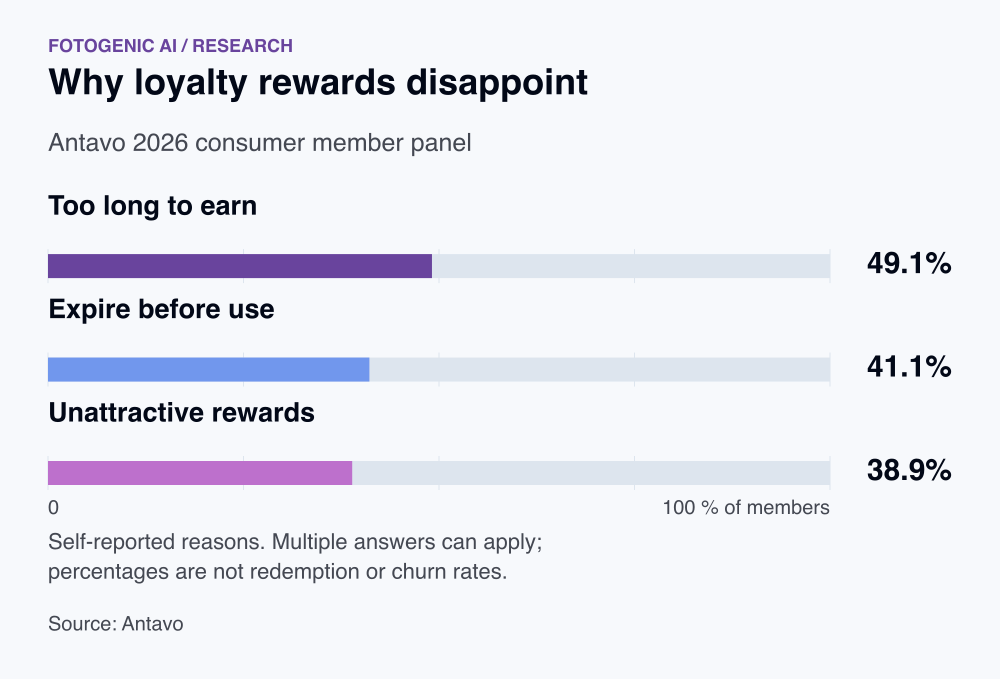
49.1% said rewards took too long to earn. [1]
Consumer disappointment reasons in Antavo’s 2026 member panel. Multiple reasons can apply; these are not observed redemption or churn rates.
41.1% said rewards expired before they could use them. [1]
Consumer disappointment reasons in Antavo’s 2026 member panel. Multiple reasons can apply; these are not observed redemption or churn rates.
38.9% said rewards were unattractive. [1]
Consumer disappointment reasons in Antavo’s 2026 member panel. Multiple reasons can apply; these are not observed redemption or churn rates.
Enrollment and active use
17.4 was the average number of loyalty memberships in Bond's 2025 US consumer survey. [4]
Surveyed consumers, not programs per ecommerce customer globally. The same summary reported 8.8 active memberships; activity lookback is not specified in its public summary.
8.8 was the average number of active loyalty memberships in the same Bond US survey. [4]
This is not an individual merchant's activation rate or proof that half of its members are active. Membership and activity means describe the surveyed US consumers.
Paid membership evidence
$5.907B was Costco's membership-fee revenue for fiscal 2026. [5]
A named warehouse retailer's paid-membership model, not program profit or an average loyalty ROI. Fiscal year ended August 30, 2026; statement amounts were reported in USD millions.
92.3% was Costco's reported US/Canada membership renewal rate at fiscal 2026 year-end. [5]
Excludes Business-member affiliates. Costco uses renewals seven to eighteen months before reporting and excludes the latest six months' expirations. Named-program renewal, not a comparison of paid versus free loyalty programs.
Observed point use and expiry
27% of earned loyalty points were left unspent in Antavo's 2025 activity summary. [1]
Point value and member activity are different denominators. The report combines surveys with separate platform data; the public summary does not give the exact point-analysis cohort.
12% of total earned points expired among programs using point expiration. [1]
2025 activity summarized in the 2026 report. This conditional program population differs from all programs; the public summary does not disclose its exact size.
Distinguish program satisfaction from incremental value
Program-owner satisfaction and member preferences answer different questions. A team can be satisfied with a program that mainly rewards customers who would have purchased anyway. Member enthusiasm for savings does not establish the margin created by the reward.
When promoting a reward product, keep its appearance consistent: plan product imagery in everyday settings.
Make the reward understandable and usable
Review the path from enrollment to the first meaningful benefit. Show what qualifies, when the reward becomes usable and which products are eligible. A visually attractive campaign cannot compensate for a reward that is difficult to understand or repeatedly unavailable.
Prepare offer imagery without changing the item: keep product images consistent across a range.
Choose points, tiers or paid membership by the promise
Points reward eligible actions and need a reachable redemption threshold. Tiers organize benefits around qualification and renewal rules. Paid membership charges for a defined benefit package and needs its own renewal economics. Early access can be a benefit within any of these structures, rather than a separate points currency.
Write the earning event, qualification period, exclusions, first usable benefit and expiry rule before designing the reward image. Test whether a new member can explain the offer. Cost the expected benefits and service workload for the eligible cohort; owner-reported ROI does not identify which structure will work for your store.
For contextual product scenes, explore lifestyle product photography while keeping reward and availability claims in the store’s own data.
Measure active use as well as enrollment
Track enrollment, earning, first redemption and renewal as separate events. Unspent points may still be valid; they are not automatically expired or owned by inactive members. The 27% and 12% findings use different program conditions.
Before promoting a reward, cost the redeemed benefit, shipping, discounts and service against the qualifying orders' contribution. Compare eligible customers with an appropriate holdout over the same follow-up; high spend among members can reflect who joined.
| Reward decision | Operating record | Measure |
|---|---|---|
| Who qualifies? | Recorded qualifying order, exclusions and eligible stock | Eligible members reaching a usable benefit |
| What is promised? | Exact reward item, threshold, expiry and fulfillment terms | Redemption and unavailable-reward incidents |
| Does it add value? | Net sales less product, discount, fulfillment and program costs | Incremental contribution per eligible member versus holdout |
FAQ
Questions about the research
Antavo’s 2026 member panel identified long earning time (49.1%), expiry before use (41.1%) and unattractive rewards (38.9%) as disappointment reasons. These are survey responses, not measured churn rates. Check how quickly a member can reach a useful reward and whether its cost is supported by actual repeat-order contribution.
Sources and method
- Antavo: Global Customer Loyalty Report 2026 findings
antavo.com
ReturnStudy details
2026 report
3,000 professionals, 10,000 loyalty members and a separate platform activity dataset. Multiple public pages describe this same research; they are one evidence family, not independent corroboration.
- Antavo: Global Customer Loyalty Report 2026 announcement
antavo.com
ReturnStudy details
February 2026
Global marketer and loyalty-member survey. Intent is not observed retention. Same underlying study as Antavo’s report page, not independent corroboration.
- Yotpo: Brand loyalty consumer research
yotpo.com
ReturnStudy details
Article updated August 2025; underlying fieldwork date unspecified
Poll of 2,000 US consumers. Stated preferences; update date alone does not establish the survey year. Do not treat as current observed redemption or causal member LTV.
- Bond, in partnership with Visa: The Bond Loyalty Report 2025: Executive Summary
352767.fs1.hubspotusercontent-na1.net
ReturnStudy details
US survey January 2-March 14, 2025; 2025 report
22,000+ US consumers examining 395+ programs in 20+ sectors. Membership/activity figures are consumer-survey summaries, not an ecommerce-only census or an individual program's activation rate. Separate third-party wallet data is not the denominator of these membership means. The public summary does not supply a precise activity lookback for the reported active-membership mean.
- Costco Wholesale Corporation: Annual Report on Form 10-K for fiscal 2026
sec.gov
ReturnStudy details
52-week fiscal year ended August 30, 2026; October 2026 filing
A named membership retailer corporate filing, not a benchmark for DTC points programs. Fee revenue is not program profit. Renewal excludes Business-member affiliates and captures renewals seven to eighteen months before reporting; the latest six months of expirations are excluded. US/Canada and worldwide populations differ.
- Yotpo: Loyalty and referrals reporting definitions
support.yotpo.com
ReturnStudy details
Documentation checked October 18, 2026
Operational definitions and report fields, not an independent performance benchmark.
How this report uses research
This report is an editorial synthesis by Fotogenic AI, updated on October 19, 2026. Source dates describe the underlying evidence. Survey responses, measured activity and forecasts are identified separately. Findings are not combined into a new market average. Multiple pages describing one study are treated as one evidence family.
Create with Fotogenic AI
Show the reward product clearly
Create product and lifestyle scenes in Fotogenic AI for the items in your loyalty offer. Keep reward eligibility, availability and terms beside the offer in your store.