Generative AI statistics
How widely generative AI is used. Why adoption is only the beginning.
Generative AI use is widespread in executive surveys, but full organizational scaling is much less common. Adoption, investment and measured task productivity are separate signals, each with a different population.
Key takeaways
Adoption and organizational scale are different milestones. In the same 2025 survey, 79% reported generative-AI use and 7% reported fully scaled AI. [1]
Keep market revenue separate from funding. Grand View Research estimated USD 22.2 billion in 2025 generative-AI revenue; Stanford recorded private investment on a different basis. [11][6]
Give productivity figures a defined task. The historical writing experiment found 40% less task time, without measuring product-image production or ecommerce sales. [5]
Key facts at a glance
Organizations reporting generative-AI use
79%reported organizational use of generative AI in 2025.
June-July 2025; organizational survey self-report
McKinseyOrganizations reporting fully scaled AI
7%said AI was fully scaled across their organization.
June-July 2025; organizational survey self-report
McKinseyEstimated generative-AI market revenue
$22.2Bwas Grand View Research's estimated worldwide generative-AI market revenue for 2025.
2025 worldwide software/services estimate
Grand View ResearchGlobal private generative-AI investment
$170.87Bin global private generative AI investment was recorded for 2025.
2025; Quid-classified private generative-AI funding
Stanford HAI, using Quid dataLess task time in a writing experiment
40%less task time was recorded with ChatGPT in a professional-writing experiment.
2023; randomized professional-writing tasks
Noy and Zhang, ScienceConsumers expecting AI-use disclosure
79%was the 30-country average agreeing that products and services using AI should disclose that use in Ipsos’ 2025 survey.
Mar-Apr 2025; average across 30 surveyed countries
Ipsos
Adoption and scaling
79% reported organizational use of generative AI in 2025. [1]
The survey covered 1,993 respondents, not a census of all businesses.
88% reported use of AI in at least one business function. [1]
This broader category includes technologies beyond generative AI.
7% said AI was fully scaled across their organization. [1]
Full-scale adoption is a stricter measure than any use.
20% of covered EU enterprises used AI in 2025. [2]
Different sampling and definitions explain why this differs from executive surveys.
8.8% used AI to generate written or spoken language. [2]
This is one technology category within the EU enterprise survey.
13.5% of covered EU enterprises used AI in 2024. [2]
Comparable all-AI enterprise figure preceding the 20.0% 2025 headline. Not a gen-AI-only adoption series.
Investment and task productivity
$285.9B was US private AI investment in 2025. [3]
AI broadly, not generative AI alone. Excludes government funding.
$12.4B was China’s private AI investment in 2025. [3]
Private investment understates total funding where government support plays a larger role.
15% higher issues resolved per hour accompanied AI assistance in a support-agent study. [4]
Updated study of 5,172 agents. Productivity effect varies by experience; not an image-generation speed or acceptance benchmark.
40% less task time was recorded with ChatGPT in a professional-writing experiment. [5]
Historical randomized study of 453 professionals. Complete writing tasks, not all work hours or image production.
18% higher rated output quality occurred in that writing experiment. [5]
Same experiment as the time finding. Evaluator-rated writing quality is separate from factual accuracy or business revenue.
Generative AI private investment
$170.87B in global private generative AI investment was recorded for 2025. [6]
Figure 4.2.3, printed page 179. Funding in classified companies, not generative AI market revenue or spending by ecommerce merchants.
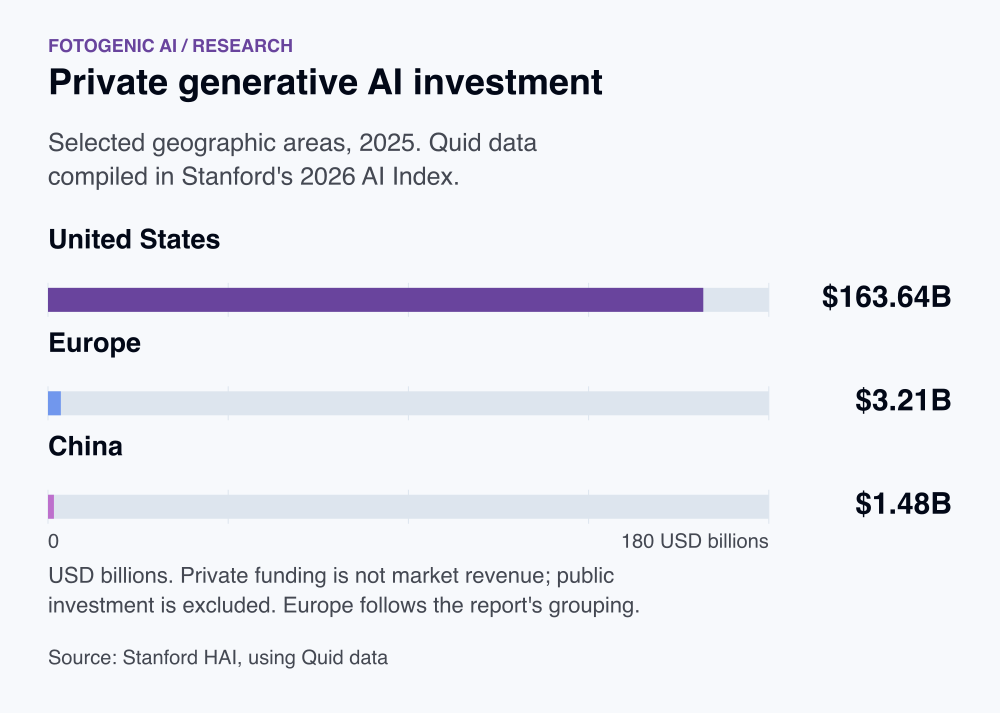
$163.64B was recorded as US private generative AI investment in 2025. [6]
Figure 4.2.10, printed page 183. Same funding dataset as the Europe and China figures; public investment is excluded.
$3.21B was recorded as European private generative AI investment in 2025. [6]
Figure 4.2.10. Europe is the report's geographic grouping, not an EU-only total. Private funding is different from total national AI expenditure.
$1.48B was recorded as Chinese private generative AI investment in 2025. [6]
Figure 4.2.10. Government-backed spending outside the private-funding dataset is excluded, limiting conclusions about total AI resources.
Public preferences and trust
79% was the 30-country average agreeing that products and services using AI should disclose that use in Ipsos’ 2025 survey. [7]
Unweighted country average, not a population-weighted global consumer share. This is a stated preference about AI generally, not proof of a universal legal disclosure duty.
48% was the 30-country average trusting companies using AI to keep personal data safe. [7]
Stated trust under the same 2025 survey methods. It does not measure actual breaches or the trustworthiness of every vendor.
Responsible AI evidence
362 documented AI incidents for 2025 were included in Stanford's 2026 AI Index account of the AI Incident Database. [8]
Recorded incidents across AI, not genAI-only harms or a merchant-tool failure rate. Records are revised and media coverage is uneven.
Named generative AI products and potential work exposure
900M weekly ChatGPT users were reported by OpenAI in April 2026. [9]
Company-reported named-product usage on April 8, 2026. It is not a count of paid subscribers or all generative AI users; detailed activity and deduplication criteria are not published in this statement.
3M weekly active Codex users were reported in the same April 2026 statement. [9]
Separate coding-agent product usage with possible ChatGPT overlap. The counts do not identify a combined unique audience or number of companies. The measurement is April 2026.
About 1 in 4 workers globally were in occupations with some potential GenAI exposure in ILO’s 2025 assessment. [10]
Task-based modeled exposure linked to employment data, not observed job losses. Jobs contain tasks requiring human input; exposure alone does not predict replacement, adoption or the timing of change.
Generative-AI revenue estimates
$22.2B was Grand View Research's estimated worldwide generative-AI market revenue for 2025. [11]
Publisher estimate for software and services across industries, not private investment, all-AI infrastructure spending or audited global transactions.
$29.6B was that publisher's estimated generative-AI market revenue for 2026. [11]
Modeled current-year market estimate. It does not measure merchant ROI or establish a separate enterprise-spending total.
Keep populations and AI definitions visible
The organizational survey and the EU enterprise statistics use different populations and definitions. Broad AI adoption includes uses beyond generative systems, while a report about a specific application may cover only one activity. These percentages are not competing estimates of the same global population.
Evaluate a visual-production task: compare image composition and lighting.
Evaluate the complete operating cost
Choose a bounded task before estimating productivity. For a garment scene, record the source image, destination, time spent, accepted result and corrections. Compare the same brief with the existing production method. The writing and support studies do not provide an apparel image-production saving.
Control the input product: review catalogue consistency.
Keep generative funding separate from revenue and ROI
Private funding measures capital supplied to companies. The separate revenue estimate measures a publisher-defined software and services market. Neither establishes the return from a merchant deployment. Use the image-generation report for visual-production evidence, rather than treating general AI growth as an image-quality result.
| Evaluation field | Product-visual task | Expansion decision |
|---|---|---|
| Scope | One exact garment, agreed view and destination | Can the task be repeated without changing the product? |
| Production outcome | Accepted files, elapsed work and correction cost | Does it improve the required production job? |
| Commercial outcome | Separate controlled placement test where appropriate | Do orders and contribution change after production costs? |
Evaluate product image generation as one specific task within the wider AI production process.
Treat trust, transparency and incident reporting as different signals
Ipsos reports public preferences and trust across a 30-country average, with its stated sampling limits. Stanford’s incident compilation concerns documented cases and uneven reporting coverage. Neither is a probability of failure for a merchant workflow.
A disclosure assessment can reveal what a developer publishes about a model. It does not replace checking the actual product details, claims and destination before customer-facing content is approved.
FAQ
Questions about the research
McKinsey’s 2025 survey reported organizational generative AI use at 79%, while 7% reported AI fully scaled across their organizations. The survey covered 1,993 respondents and is not a census of every company. Any-use and full-scale deployment are different maturity measures, and all-AI enterprise statistics use another technology definition.
Sources and method
- McKinsey: AI at work but not at scale
mckinsey.com
ReturnStudy details
June-July 2025 survey
1,993 respondents across organizational levels. Self-reported adoption.
- Eurostat: Enterprise AI use in 2025
ec.europa.eu
ReturnStudy details
2025
EU enterprises with at least 10 employees in covered sectors.
- Stanford HAI: 2026 AI Index Report
hai.stanford.edu
ReturnStudy details
2026 report; 2025 investment
Cross-source research synthesis. Private AI investment covers AI broadly, not generative AI alone; private investment omits public funding and is not software revenue.
- Brynjolfsson, Li and Raymond: Generative AI at Work
arxiv.org
ReturnStudy details
Updated research version checked October 18, 2026
Staggered deployment among 5,172 customer-support agents. Productivity is issues resolved per hour; heterogeneous effects. Different from the earlier 14% working-paper estimate, and not a product-image study.
- Noy and Zhang, Science: Experimental evidence on the productivity effects of generative artificial intelligence
science.org
ReturnStudy details
July 2023 experiment
Preregistered experiment with 453 college-educated professionals completing incentivized occupation-specific writing tasks. Half were randomly exposed to ChatGPT. Historical task-time and evaluator-rated quality outcomes, not a current tool comparison or merchant sales effect.
- Stanford HAI, using Quid data: 2026 AI Index, Economy: generative AI investment
hai.stanford.edu
ReturnStudy details
2025 funding; 2026 report
Quid-classified private investment in AI/ML firms with over $1.5 million funding since 2013. Figures 4.2.3 and 4.2.10, printed pages 179 and 183, distinguish generative AI from all AI. Private funding is not sales, market revenue or total public investment. Geographic coverage and classification limit country comparisons.
- Ipsos: AI Monitor 2025
ipsos.com
ReturnStudy details
March 21-April 4, 2025 fieldwork; June 2025 report
23,216 respondents across 30 countries. Most sampled ages 16-74, with country-specific adult-age thresholds; India included face-to-face interviews and its urban population subset. Results shown here are the unweighted average of country percentages, not a population-weighted global share. Some countries represent more connected/urban/affluent segments. Stated opinions about AI, not sales outcomes or acceptance of every generated product image.
- Stanford HAI AI Index, compiling AI Incident Database records: AI Index Report 2026, Chapter 3: Responsible AI
hai.stanford.edu
ReturnStudy details
2025 incident records as represented in the 2026 report
Documented AI incidents compiled from human-reviewed reports with thresholds for AI involvement. Coverage favors English-language media and high-visibility cases. Counts are revised over time and are not an incidence rate, total harms, a genAI-only measure or a risk rate for a merchant image tool.
- OpenAI: The next phase of enterprise AI
openai.com
ReturnStudy details
April 8, 2026 company statement
Company-reported product usage. ChatGPT is described as having 900 million weekly users; Codex as having 3 million weekly active users. The statement does not disclose the precise activity event, deduplication rules or paid/free breakdown. These are separate named-product populations, not all generative AI users, organizations, paid subscribers or a consumer census. The figures are dated April claims, not newly measured October totals.
- International Labour Organization and NASK: Generative AI and jobs: A 2025 update
ilo.org
ReturnStudy details
May 20, 2025 index and research brief
Task-based potential occupational exposure model, combining nearly 30,000 tasks, expert assessment and AI predictions, linked to employment/labour-force microdata. About one quarter of global employment falls in occupations with some GenAI exposure. It is not observed use, an estimate of actual job losses or a prediction that one quarter of workers will be replaced. The original employment analysis covers more than 140 countries. Rounded descriptions vary between about 24% and 25% across ILO summaries.
- Grand View Research: Generative AI Market, 2026-2033
grandviewresearch.com
ReturnStudy details
2026 report summary; April 2026 associated press release; 2025 base-year estimate
Publisher estimate of worldwide generative-AI software and services revenue across model builders, app builders, applications and industries. Distinct from private funding, all-AI infrastructure spending and enterprise-only spend. Proprietary market estimates and forecasts are not audited transaction totals; detailed paid tables and model inputs were not inspected.
- Stanford CRFM and collaborating academic researchers: Foundation Model Transparency Index, December 2025
crfm.stanford.edu
ReturnStudy details
December 2025 edition
Research assessment of 13 developers against 100 disclosure indicators in December 2025. Criteria changed from 2024. Transparency concerns public disclosure, rather than certification of safety, product fidelity or legal compliance.
- Pinterest Research: Pinterest Canvas: Large-Scale Image Generation at Pinterest
arxiv.org
ReturnStudy details
June 2026 revision; KDD 2026 accepted paper
Platform-authored research. Table 2 reports relative online A/B engagement changes for background and aspect-ratio outpainting against different original-image controls. Table 1 reports human quality checks on 996 products, two trained raters per output. No merchant sales, profit or return outcome is established. Model versions and tasks are specific to this evaluation.
How this report uses research
This report is an editorial synthesis by Fotogenic AI, updated on October 19, 2026. Source dates describe the underlying evidence. Survey responses, measured activity and forecasts are identified separately. Findings are not combined into a new market average. Multiple pages describing one study are treated as one evidence family.
Create with Fotogenic AI
Evaluate generative AI on a product-visual task
Use Fotogenic AI to create a scene from a product image and compare the result with your brief. Judge the usable asset and production effort before expanding the workflow.