AI image generation statistics
Where creative AI is being used. What it takes to approve an image.

AI image generation statistics cover different questions: market revenue, creative use, advertising clicks and usable product images. Compare each on its own terms before setting an apparel image-production budget.
Key takeaways
Creative speed still needs review capacity: 93% of surveyed creative-AI users reported faster production, while 57% said outputs needed moderate or extensive editing. [3]
Approve the product and its setting together. Only 47.2% of Pinterest Canvas outputs passed both checks in the study's human evaluation. [5]
Generated backgrounds can improve ad engagement: Pinterest measured an 18.0% relative CTR lift, without establishing a corresponding increase in completed purchases. [5]
Key facts at a glance
Estimated image-generator market revenue
$474.2Mwas Grand View Research's estimate of global AI-image-generator revenue in 2025.
2025 worldwide software/services estimate
Grand View ResearchCTR lift from generated backgrounds
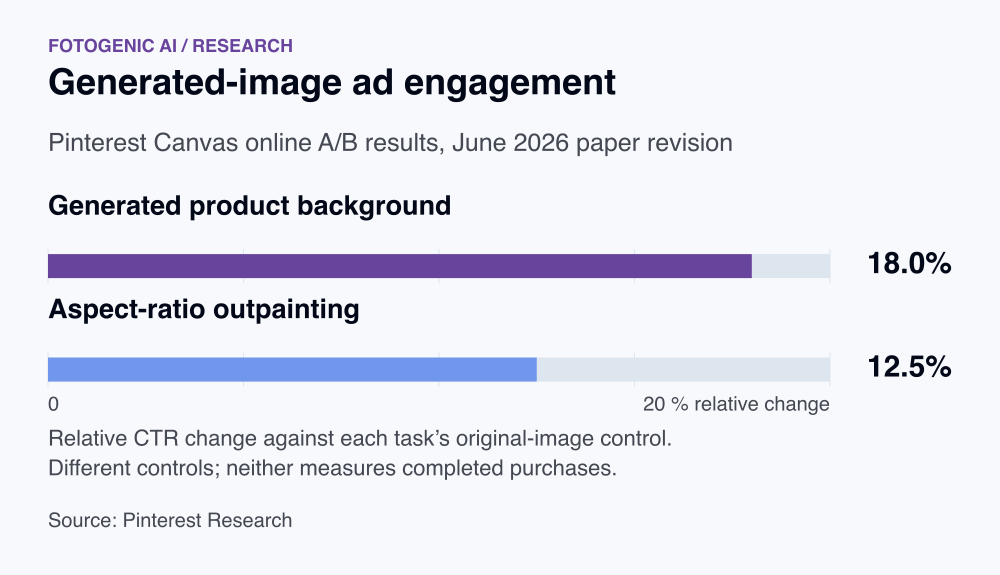
18.0%relative CTR lift followed generated product backgrounds in Pinterest’s A/B tests.
June 2026 paper; platform A/B engagement
Pinterest ResearchOutputs passing both quality checks
47.2%of Pinterest Canvas outputs passed both product and background quality checks.
June 2026 paper; 996-product human review
Pinterest ResearchCreators needing substantial output editing
57%said creative AI outputs typically needed moderate or extensive editing.
May 2026; income-generating social creators
Adobe / The Harris PollQuality skepticism about AI model ads
38%were skeptical of product quality when holiday ads used AI-generated models.
March 2026; 1,246 North American adults
BazaarvoiceCreators reporting faster production
93%said creative AI helped them produce content faster.
May 2026; creative-AI user self-report
Adobe / The Harris Poll
Creative AI adoption and workflow
9.5% of covered EU enterprises used AI to generate pictures, video or audio. [1]
The 2025 measure combines media types. It is not an image-only adoption rate.
55% of surveyed creators reported editing, upscaling or enhancement uses. [2]
The 2025 survey covered social creators, not all designers or businesses.
52% reported generating new assets such as images and video. [2]
Images and video are combined in this response category.
57% said creative AI outputs typically needed moderate or extensive editing. [3]
The 2026 finding makes review effort part of production planning.
53% of B2B marketers used or were implementing AI creative-asset tools. [4]
This includes image, video and visual editing tools, not only text-to-image generation.
93% said creative AI helped them produce content faster. [3]
Creator self-report; no measured number of hours saved or product-fidelity score.
35% said creative AI gave them more freedom to experiment before pitching. [3]
Benefits were self-reported by creative-AI users, not measured ecommerce outcomes.
33% said it gave them confidence to attempt more ambitious projects. [3]
Creative AI includes images, video, audio and design, not image generation alone.
Image-specific engagement and quality
18.0% relative CTR lift followed generated product backgrounds in Pinterest’s A/B tests. [5]
Original white-background images were the control. Click-through is an engagement outcome, not a purchase-conversion result.
12.5% relative CTR lift followed aspect-ratio outpainting in a separate Pinterest treatment. [5]
The control already had a lifestyle background. This separate experiment uses a different baseline, so the two lifts are not additive.
84.0% passed the product-quality check for Pinterest Canvas background outputs. [5]
Human evaluation of 996 products, two trained raters per output. Product preservation was assessed separately from background quality. Not a Fotogenic AI acceptance rate.
47.2% of Pinterest Canvas outputs passed both product and background quality checks. [5]
The combined gate is stricter than the product-only gate. It shows why an attractive background alone cannot define approval.
Consumer acceptance of commercial AI imagery
38% were skeptical of product quality when holiday ads used AI-generated models. [6]
March 2026 survey of 1,246 North American adults. A stated response to model imagery in holiday ads, not all generated backgrounds or observed purchases.
Public preferences and trust
62% was the 30-country average preferring human-created social-platform advertising content over AI in Ipsos’ 2025 survey. [7]
Preference for ad-content authorship, not a blind image-identification test or measured purchase penalty. It should complement, not replace, image-specific consumer acceptance research.
Image-generation market estimates
$474.2M was Grand View Research's estimate of global AI-image-generator revenue in 2025. [8]
Software and services market estimate, not spending on accepted ecommerce images or a count of generated files.
$555.1M was the same publisher's estimated AI-image-generator market for 2026. [8]
A modeled current-year estimate, not a completed-year audited result. Its revenue definition includes software and supporting services.
Separate adoption from production quality
The datasets cover different populations and different uses of AI. An enterprise generating audio or video belongs to a broader category than a merchant producing a product photograph. Creator adoption also does not tell you how many generated assets were accepted for commercial use.
Check exact garment details: build consistent clothing images.
Build an apparel image brief
Start with the source photograph of the exact garment and variant. Specify the view, background, garment details that must remain visible and intended placement. Keep print, seams, fastenings and color in the acceptance record; a different setting should not become a different product.
Translate the acceptance checklist into a brief: write a product-photography prompt.
Approve the asset for its actual destination
A packshot needs faithful outline, color and construction. A lifestyle scene also needs credible scale and object contact. An on-model view needs garment and person continuity. Review those requirements separately before counting the file as usable. A polished background cannot compensate for a changed product.
Keep the source photograph and rejected outputs in the review record. Test a fixed brief against the existing workflow using accepted assets, review time and correction cost. Creator adoption and technical quality checks do not establish how shoppers will trust a particular generated product scene.
The AI product image generator describes scene creation; product-fidelity approval remains a separate review step.
Do shoppers accept AI-generated product images?
Acceptance depends on the use. Bazaarvoice's 2026 holiday survey found quality skepticism about AI-generated models. That question does not measure reaction to generated backgrounds around a factual product photograph. Keep the product reference inspectable and distinguish appearance, accuracy and trust when evaluating an asset.
Read market size and production cost separately
The market estimate counts supplier revenue across software and services. It cannot tell a merchant the price of a finished catalogue image. Use the actual invoice and production record: generation, review, corrections and destination preparation divided by the accepted assets delivered.
Record outputs attempted and assets accepted separately. A reliable global annual image-output count is not established by these sources; neither a revenue forecast nor a multi-media adoption survey can supply it.
| Production record | Include | Decision |
|---|---|---|
| Input and brief | Exact garment variant, required views and destination | Can the same product be checked throughout? |
| Production cost | Generation charge, reviewer time, correction and export work | What did the delivered set actually cost? |
| Accepted output | Files meeting the agreed product and placement requirements | What is total cost per accepted asset? |
FAQ
Questions about the research
Pinterest’s Canvas experiments reported relative CTR lifts of 18.0% for generated backgrounds and 12.5% for aspect-ratio outpainting against different original-image controls. A separate human evaluation found 47.2% of Canvas outputs passed both product and background checks. Engagement and image approval are different outcomes; neither establishes a universal purchase lift for a merchant tool.
Sources and method
- Eurostat: Enterprise AI use in 2025
ec.europa.eu
ReturnStudy details
2025
EU enterprises with at least 10 employees in covered sectors.
- Adobe / The Harris Poll: Creators Toolkit 2025
news.adobe.com
ReturnStudy details
September 2025
16,000+ social creators across eight countries; mainly emerging and semi-professional creators.
- Adobe / The Harris Poll: Creators Toolkit 2026
news.adobe.com
ReturnStudy details
May 2026
16,000+ income-generating social creators across eight countries. Creative AI spans multiple media.
- Content Marketing Institute: B2B content and marketing trends for 2026
contentmarketinginstitute.com
ReturnStudy details
2026 report
B2B marketer survey. Not an ecommerce-only sample or a causal study.
- Pinterest Research: Pinterest Canvas: Large-Scale Image Generation at Pinterest
arxiv.org
ReturnStudy details
June 2026 revision; KDD 2026 accepted paper
Platform-authored research. Table 2 reports relative online A/B engagement changes for background and aspect-ratio outpainting against different original-image controls. Table 1 reports human quality checks on 996 products, two trained raters per output. No merchant sales, profit or return outcome is established. Model versions and tasks are specific to this evaluation.
- Bazaarvoice: Why authentic holiday content is key to your holiday marketing strategy
bazaarvoice.com
ReturnStudy details
March 2026 survey; April 14, 2026 publication
1,246 North American shoppers aged 18+. Stated holiday trust and purchase preferences. Public article gives no weighting, country split or questionnaire. Does not estimate actual conversion or all generated product photography.
- Ipsos: AI Monitor 2025
ipsos.com
ReturnStudy details
March 21-April 4, 2025 fieldwork; June 2025 report
23,216 respondents across 30 countries. Most sampled ages 16-74, with country-specific adult-age thresholds; India included face-to-face interviews and its urban population subset. Results shown here are the unweighted average of country percentages, not a population-weighted global share. Some countries represent more connected/urban/affluent segments. Stated opinions about AI, not sales outcomes or acceptance of every generated product image.
- Grand View Research: AI Image Generator Market, 2026-2033
grandviewresearch.com
ReturnStudy details
September 2026 public-summary revision; 2025 estimate and 2026-2033 forecast
Publisher model of worldwide AI-image-generation software and services revenue. Software includes licensing, APIs, subscriptions and editing; services include implementation, integration, training and support. Public methodology describes executive interviews, secondary research and supply/demand triangulation. Estimates are not audited market transactions, an image count or merchant production cost; full tables were not purchased.
- Ghosh, Hajishirzi and Schmidt: GenEval: evaluating text-to-image alignment
arxiv.org
ReturnStudy details
October 2023 research
Object-focused compositional benchmark. Evaluates count, position, color and related alignment; does not measure merchant product fidelity, commercial acceptance or profitability.
How this report uses research
This report is an editorial synthesis by Fotogenic AI, updated on October 19, 2026. Source dates describe the underlying evidence. Survey responses, measured activity and forecasts are identified separately. Findings are not combined into a new market average. Multiple pages describing one study are treated as one evidence family.
Create with Fotogenic AI
Build the product images your brief needs
Use Fotogenic AI to create product scenes from your source images, then review the garment details and crops for your catalogue.