AI adoption in ecommerce statistics
How AI is changing online shopping. Where adoption and trust differ.

AI adoption looks different in an ecommerce-business survey, an enterprise census and a shopper survey. Current use, purchase trust and planned investment are presented separately so you can compare the relevant population.
Key takeaways
AI is already part of many ecommerce operations: 67% of businesses in DHL's survey reported using it somewhere across their platforms. [3]
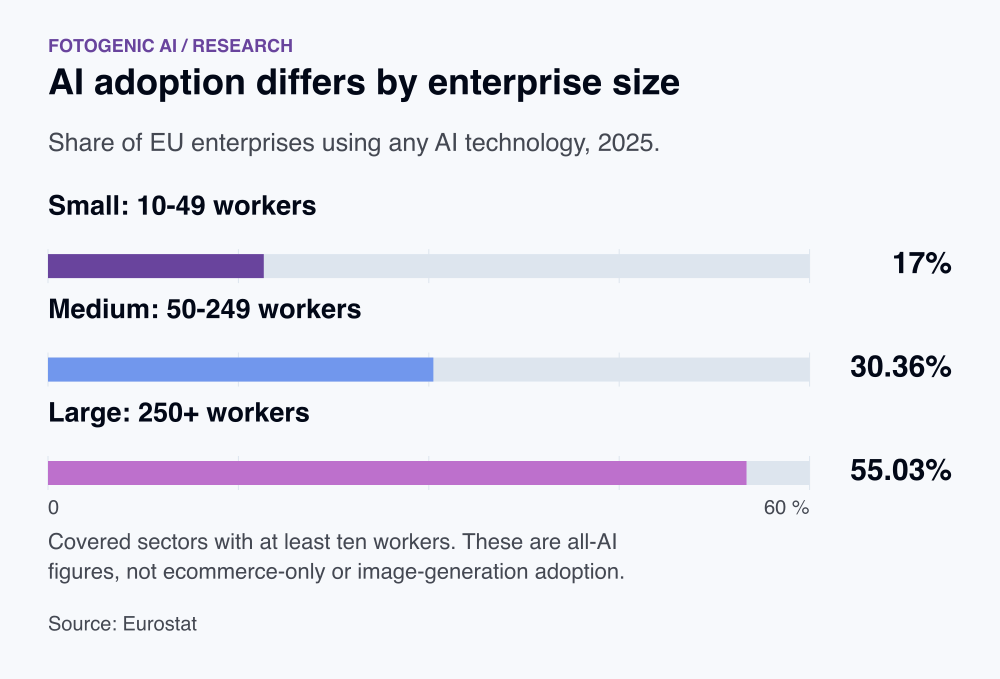
Adoption varies with company size. Eurostat recorded AI use at 17% of small covered EU enterprises and 55.03% of large ones in 2025. [6]
Choose a specific task before setting an AI target. The retail chatbot experiment measured presale support; its sales result is not an image-generation benchmark. [7]
Key facts at a glance
Ecommerce businesses reporting AI use
67%of DHL-surveyed ecommerce businesses reported some AI use across their platforms.
Dec 2025-Feb 2026; 5,800 ecommerce businesses
DHL eCommerceEuropean fashion marketers using AI
80%of surveyed European fashion marketing decision makers reported using AI in marketing.
2026 report; 616 European fashion marketers
KlaviyoSales lift in a retail chatbot experiment
16.3%relative sales lift followed a presale AI chatbot in one retail experiment.
2025 preprint; one retail platform, no-support control
Cui and coauthors / arXivSmall EU enterprises using AI
17%of small EU enterprises used some form of AI in 2025.
2025; covered EU firms with 10-49 workers
EurostatLarge EU enterprises using AI
55.03%of large EU enterprises used AI.
2025; covered EU firms with 250+ workers
EurostatBusinesses planning more generative AI use
73%of surveyed businesses expected to use generative AI more within five years.
June 2026 release; business plans, not deployment
DHL
Retailer use and intentions
73% of surveyed businesses expected to use generative AI more within five years. [1]
This is an intention, not a count of completed deployments.
59% expected shoppers to browse and buy through virtual assistants. [1]
A business expectation should inform preparation without becoming a sales forecast.
61% of surveyed B2B retailers reported already using AI. [2]
Observed adoption as reported by businesses, separate from future expectations.
67% of DHL-surveyed ecommerce businesses reported some AI use across their platforms. [3]
Page 30. Selected active ecommerce businesses, not all EU enterprises or a census of retailers. Keep the Eurostat population separate.
Shopper use and trust
29% of shoppers were willing to let AI make purchases within five years. [1]
Willingness is not current autonomous-shopping usage.
22% of shoppers used AI for product research. [4]
The survey covered online shoppers in three markets.
14% trusted AI enough to rely on it regularly. [4]
Product information still needs to be understandable and verifiable.
43% accepted AI text summaries as a shopping aid. [5]
Survey response about assistive AI, not authorization for autonomous purchases.
41% accepted Q&A chatbots as a shopping aid. [5]
The public release gives no sample size; use as directional evidence.
Enterprise size and experimental outcomes
17% of small EU enterprises used some form of AI in 2025. [6]
Small means 10-49 workers in covered sectors. This is not an ecommerce-only adoption rate.
30.36% of medium EU enterprises used AI. [6]
Medium means 50-249 workers; the same covered-sector denominator applies.
55.03% of large EU enterprises used AI. [6]
Large means at least 250 workers. Company size comparisons concern all AI technologies.
16.3% relative sales lift followed a presale AI chatbot in one retail experiment. [7]
Working-paper result versus no presale support, not versus a strong human team. One platform; no product-image generation was tested.
Which AI tasks retailers offer
59% of DHL-surveyed ecommerce businesses reported offering AI product reviews or images. [3]
Page 30 combines reviews and images in one feature question. It does not isolate generated product photographs or measure accepted-image quality.
58% reported offering AI customer service, chatbots or virtual assistants. [3]
Current self-reported feature use in the business sample, distinct from shopper experience and future plans. It is not a measured reduction in support costs.
Barriers among enterprises considering AI
70.3% cited insufficient expertise among covered EU enterprises that had considered AI but were not using it in 2025. [8]
The denominator is AI-considering non-users in Eurostat's covered 10+worker population, not all ecommerce businesses. Multiple reasons could be selected.
53.6% cited unclear legal consequences in that same AI-considering non-user population. [8]
Stated barrier, not a finding that AI use is unlawful or that 53.6% of all firms face the same obstacle.
52.7% cited data-protection or privacy concerns in that same population. [8]
Nonexclusive reported reasons among enterprises that considered AI but did not adopt it.
43.5% cited availability or quality of necessary data in that same population. [8]
Useful for evaluating readiness, not evidence that a specific merchant's data is unsuitable.
41.6% cited incompatibility with existing equipment, software or systems in that same population. [8]
An adoption barrier reported by AI-considering non-users, not an observed failure rate of deployed AI.
Fashion marketing AI adoption
80% of surveyed European fashion marketing decision makers reported using AI in marketing. [9]
616 decision makers in five countries. Marketing AI spans several tasks; this does not isolate image generation or prove useful deployment.
Map adoption to a specific business task
Select the business decision before selecting the tool: produce a garment image, answer an order question or recommend an available variant. The fashion survey adds a directly relevant merchant population, while DHL and Eurostat describe different business groups. None makes these tasks interchangeable.
Start with one apparel production task: create apparel images for WordPress pages.
Protect product truth across channels
Use the catalog as the source for price, availability, variants and product attributes. Generated descriptions or images should be checked against those facts. A polished response becomes unhelpful when it recommends an unavailable variant or describes an accessory that is not included.
Keep the input and approved result connected: review the product-image workflow.
Separate deployed features from useful operating capability
DHL's task questions distinguish service, product content and personalization. A retailer can report offering a feature while still needing product-data cleanup, review and exception handling. Start with a task whose inputs and correct outcome can be checked, such as matching a creative asset to an exact variant.
Document the input record, human approval point and fallback when data is missing. Compare the proposed feature with the service it replaces. Use adoption evidence to understand deployment, then use your own accepted-output cost and outcome measurements to decide whether to expand it.
Compare the visual-production tasks on the Fotogenic AI features page before choosing one bounded deployment.
Choose the task, inputs and customer promise
Different AI tasks need different source information and success measures. The deployment percentages describe reported features; the operating decisions below explain what has to work for the customer.
| Merchant task | Source of truth | Failure response |
|---|---|---|
| Garment scene creation | Source product image and exact variant | Reject changed construction or print; use the existing approved image |
| Order assistance | Current order and delivery records | Route unresolved requests to the store's support team |
| Product recommendations | Eligible stock, attributes and customer permissions | Show an available general selection when context is insufficient |
FAQ
Questions about the research
DHL’s 2026 survey found 67% of responding ecommerce businesses used some AI across their platforms. Its business sample covered 5,800 active sellers in 28 countries. This is a different population from Eurostat’s covered EU enterprises, which exclude businesses with fewer than ten workers. Use the source closest to the business and workflow you are evaluating.
Sources and method
- DHL: E-Commerce Trends Report 2026
group.dhl.com
ReturnStudy details
June 2026 release
29,000 shoppers and 5,800 businesses across 29 countries. Survey responses.
- DHL: E-Commerce Trends Report 2025, Business Edition
group.dhl.com
ReturnStudy details
October 2025 release
Survey of 4,050 ecommerce businesses in 19 markets. Business self-reports and plans, not transaction records or shopper responses.
- DHL eCommerce: 2026 E-Commerce Trends Report, full research and methodology
dhl.com
ReturnStudy details
Fieldwork December 2025-February 2026
29,000 recent online shoppers in 29 countries and 5,800 businesses in 28 countries; 1,000 shoppers per country. Grocery, tickets and flights excluded. Shopper and business responses are distinct. Cited findings appear on pages 5, 30 and 42; methodology is on page 78. The try-on/fit interest measure on page 42 concerns only the app-first shopper subgroup. Self-reported adoption, reasons and preferences do not establish transaction outcomes.
- Salsify: 2026 Consumer Research
salsify.com
ReturnStudy details
October 2025 survey; January 2026 release
2,712 online shoppers in the US, UK and Canada. Self-reported behavior.
- Bazaarvoice: Shopper Experience Index 2026: research before purchase
bazaarvoice.com
ReturnStudy details
June 23, 2026 release
Self-reported shopper behavior. The public release does not supply sample size, fieldwork dates or country mix, limiting generalization. Discovery archetypes are not measured sales attribution.
- Eurostat: AI use by enterprise size and purpose
ec.europa.eu
ReturnStudy details
2025 enterprise survey
Covered EU sectors with at least ten workers. Small: 10-49; medium: 50-249; large: 250+. All AI, not ecommerce-only or generative-image-only. Marketing-purpose percentage uses AI-using enterprises as denominator.
- Cui and coauthors / arXiv: Generative AI and Firm Productivity: Field Experiments in Online Retail
arxiv.org
ReturnStudy details
October 2025 working paper, version 1
Randomized workflows at one cross-border platform. Effects are relative to workflow-specific controls. The study is a preprint and does not test product-image generation. Support control offered no presale assistance; message sales effect was not statistically significant.
- Eurostat: The use of artificial intelligence technologies in the European Union: Table 7
ec.europa.eu
ReturnStudy details
2025 enterprise survey; 2026 analytical publication
Covered EU enterprises with at least 10 employees and self-employed people in specified non-financial sectors. Reason figures concern enterprises that had considered AI but were not using it, not all enterprises, all ecommerce brands or firms with fewer than 10 workers. Reasons are nonexclusive survey responses. Approximately 157,000 enterprises participated in the overall 2025 ICT survey; this is not the size of the reason-question subset.
- Klaviyo: The 2026 State of Fashion Marketing in Europe
klaviyo.com
ReturnStudy details
2026 report
616 fashion marketing decision makers in the UK, Germany, France, Italy and Spain. Vendor survey and self-reported marketing AI use, not a census or image-only adoption. The cited public landing page directly states 80% but does not expose fieldwork dates, weighting or task-specific question bases.
- Eurostat: Enterprise AI use in 2025
ec.europa.eu
ReturnStudy details
2025
EU enterprises with at least 10 employees in covered sectors.
How this report uses research
This report is an editorial synthesis by Fotogenic AI, updated on October 19, 2026. Source dates describe the underlying evidence. Survey responses, measured activity and forecasts are identified separately. Findings are not combined into a new market average. Multiple pages describing one study are treated as one evidence family.
Create with Fotogenic AI
Choose one visual task for your AI rollout
Start with product scenes in Fotogenic AI using a garment you can inspect against its source image. Define the required placement before expanding production.