Influencer marketing statistics
What brands look for in creators. How to evaluate the right partnership.
Influencer marketing combines audience access, creative production and usage rights. Buyer selection criteria and creator payment distributions help frame a brief, but neither provides a universal per-post price or campaign ROI.
Key takeaways
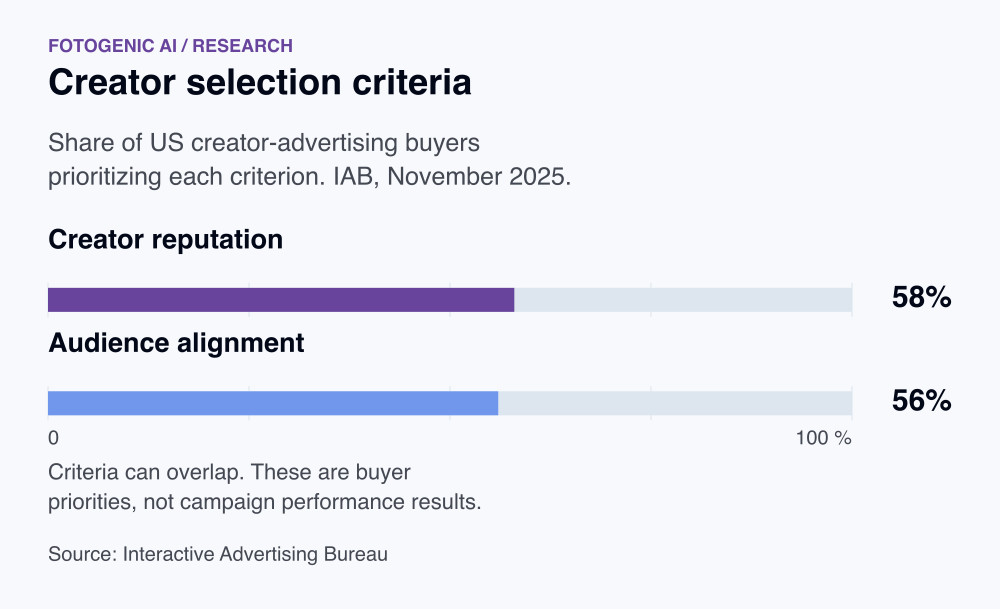
Choose a creator for audience fit and reputation. These were leading criteria for 56% and 58% of surveyed US creator-advertising buyers. [2]
Ask for a scoped quote. CreatorIQ's selected annual payment dataset had a USD 3,000 median and USD 11,400 mean; neither is a universal per-post rate. [5]
Keep the creator's audience in the brief. Among surveyed creators, 42% reported tension between audience preferences and brand requests. [4]
Key facts at a glance
Buyers prioritizing creator reputation
58%rated creator reputation among the leading selection criteria.
Nov 2025; US creator-advertising buyers
Interactive Advertising BureauBuyers prioritizing audience alignment
56%prioritized audience alignment.
Nov 2025; US creator-advertising buyers
Interactive Advertising BureauMedian annual earnings in tracked payments
$3,000was median creator earnings within CreatorIQ’s selected 2025 payment dataset.
2025; selected creator-platform payments, annual
CreatorIQAd buyers planning more creator focus
57%of ad buyers expected more focus on creator or influencer partnerships in 2026.
Jan 2026; 205 ad buyers, planned focus
Interactive Advertising BureauCreators reporting audience and brand tension
42%of creators reported tension between audience preferences and brand requests.
May-June 2026; 5,095 creator self-reports
CreatorIQ and Influencers.clubBrands reporting creator ROI of at least three times
48%of brands in CreatorIQ's latest survey reported creator-marketing ROI of at least 3x.
2026 brand subset; self-reported ROI, definitions vary
CreatorIQ and Sapio Research
Advertiser priorities and selection
57% of ad buyers expected more focus on creator or influencer partnerships in 2026. [1]
The 205-respondent wave measures intended time or resources.
58% rated creator reputation among the leading selection criteria. [2]
Reputation should be evaluated alongside product and audience fit.
56% prioritized audience alignment. [2]
A large audience is not automatically the right audience.
40% ranked overall ROI as their top creator-campaign KPI. [2]
An ROI goal still requires a defined cost and attribution method.
48% considered creators a must-buy advertising channel. [3]
Buyer sentiment does not establish a return for any individual campaign.
Creator constraints and payment distributions
42% of creators reported tension between audience preferences and brand requests. [4]
Creator-side survey evidence, distinct from advertiser selection criteria.
53% of creators with at least 500,000 Instagram followers reported that tension. [4]
A subgroup result for the stated creator population; small creators may have a different share.
$3,000 was median creator earnings within CreatorIQ’s selected 2025 payment dataset. [5]
Platform payments are not per-post fees or complete annual creator income; licensing and off-platform compensation are excluded.
$11,400 was the corresponding mean in that payment dataset. [5]
Same platform sample, not an independent estimate. The mean is sensitive to large payments.
2026 brand investment and measurement
48% of brands in CreatorIQ's latest survey reported creator-marketing ROI of at least 3x. [6]
September 2026 release; self-reported brand-subset result. Public ROI definitions and attribution windows are not standardized, so this is not a profit guarantee.
33% year-over-year growth in average annual creator-marketing investment was reported. [6]
Survey-reported investment change in the 2026 study, not total worldwide industry growth or a recommended budget increase.
27% of brands cited integration of creator data and workflows as a roadblock. [6]
Brand-specific response within the larger marketer survey. It describes implementation friction, not a measured reduction in campaign performance.
Platform mix and audience access
82% of surveyed creators used YouTube in Patreon's cross-platform sample. [7]
US creator survey with overlapping platform use. Instagram 79% and TikTok 75% were also reported; these are not engagement or purchase-conversion rates.
79% of creators in the same survey used Instagram. [7]
Same sample and overlapping use, not an independent study. Platform reach must still be checked for a proposed partner's audience.
75% of creators in the same survey used TikTok. [7]
Historical US creator sample. Viewer engagement and advertiser budget shares use different populations and denominators.
Brand programs across platforms
99% of CreatorIQ customers used Instagram during its August 2025-July 2026 observation window. [8]
Selected platform customers; multiple platforms could be used. This is not global brand adoption, spend share or a finding that Instagram produces the best ROI.
93% of the same CreatorIQ customer population used TikTok. [8]
Same customer-use window and denominator as Instagram. The separate 2,000-person brand/agency survey is a different population.
80% of that CreatorIQ customer population used YouTube. [8]
Observed customer platform use, not comparative conversion or a prescribed channel mix.
79% of that CreatorIQ customer population used Facebook. [8]
Same selected vendor customer population and observation window. The percentages are nonexclusive.
Compare one complete creator proposal
Commission the product demonstration you need, then assess whether a creator's audience and evidence fit it. A garment brief should state the exact item, the visible action, the buying question and the placements. Set production and audience-distribution fees separately when both are being purchased.
| Proposal field | Apparel commission requirement | Evidence or agreement |
|---|---|---|
| Product demonstration | Show the exact garment worn or handled, including key construction details | Source item, creator's actual experience and final deliverable |
| Audience and distribution | Name platform, audience geography and reporting window | Recent platform-native views and audience data with denominator |
| Production and rights | Specify files, revisions, delivery, usage duration and paid amplification | Itemized quote and written permitted uses |
| Evaluation | Separate accepted content, distribution and qualifying orders | Fees, product/shipping, paid spend, refunds and deduplicated order record |
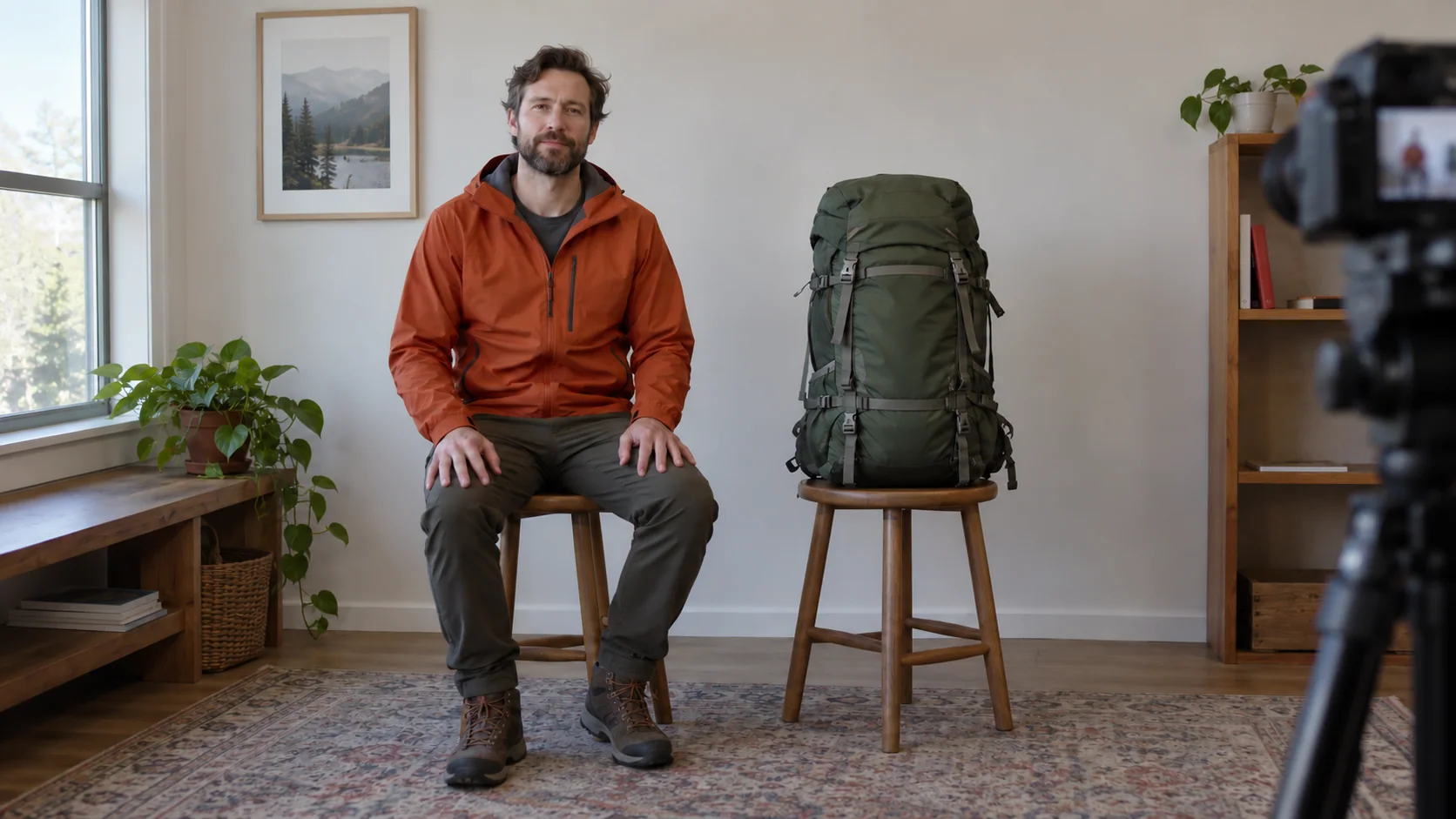
Give the creator an accurate product reference: write a garment campaign brief.
Approve US-facing endorsements before release
Use an approval record for the final endorsement and its disclosure. FTC staff guidance recommends clear instructions, reasonable monitoring and action on problems. Its FAQ also recommends reviewing paid posts before release. Confirm reuse rights separately from these advertising checks.
| Review | Check | Approval record |
|---|---|---|
| Relationship | Identify payment, gifts or other material connections | The relationship and planned disclosure |
| Experience and claims | Confirm genuine product experience and supported product claims | Approved factual claims and final creative |
| Disclosure placement | Put clear disclosure with the endorsement; include it in video and repeat it during live streams | The disclosure as it appears in each final format |
| Release and reuse | Inspect the published version; correct missing disclosure or unsupported claims | Approved post, monitoring result and any correction |
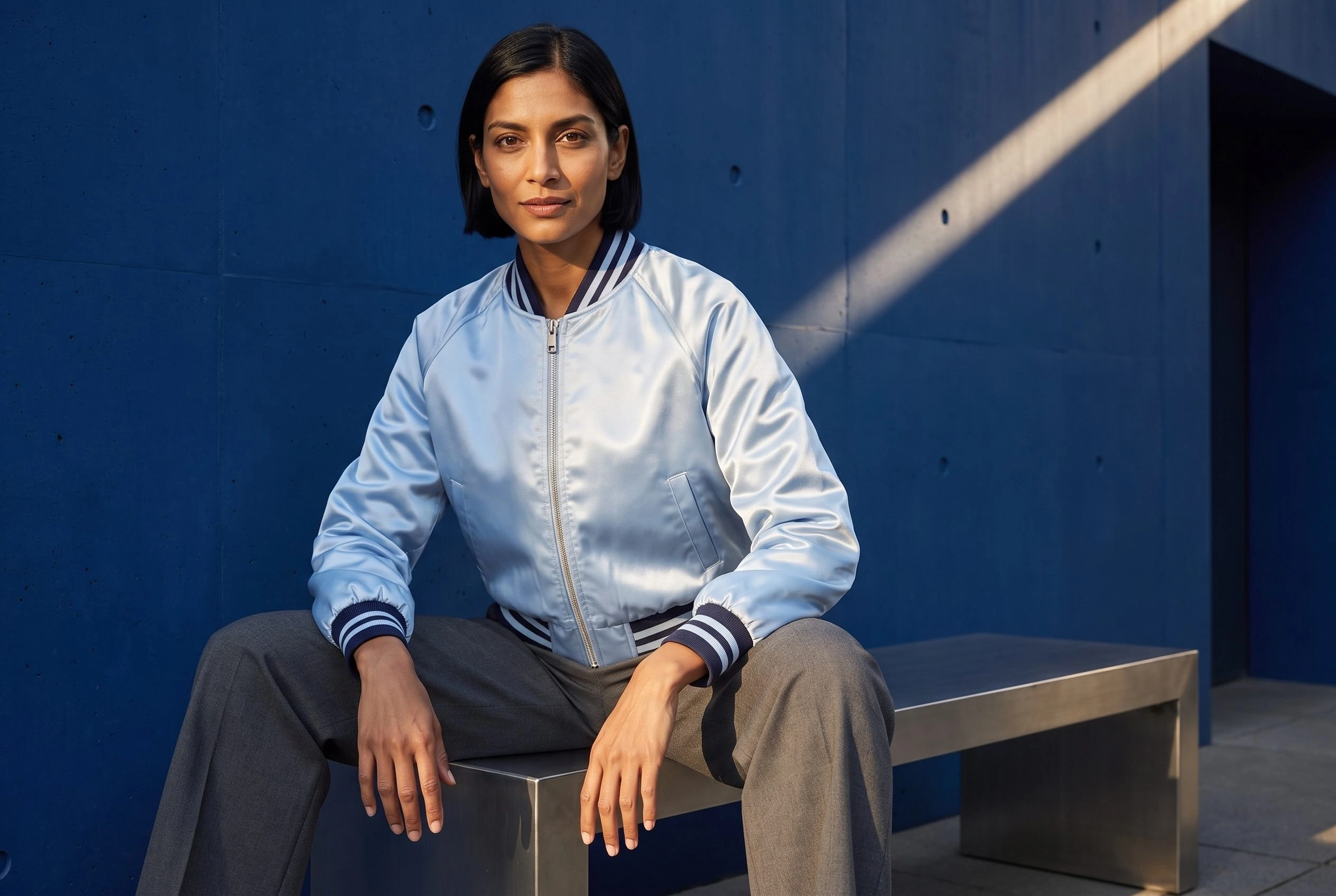
Set specific visual requirements for the partnership: direct the action in an on-model scene.
Report content, distribution and sales separately
Report usable assets, organic distribution, paid amplification and qualifying orders as separate outcomes. A paid promotion can add reach beyond the creator's own audience. Agree the reporting window and order rules before launch, then deduplicate creator, affiliate and paid-media orders.
Self-reported brand ROI does not standardize the return calculation for every respondent. For your own campaign, include the agreed fees, product costs and amplification in the relevant cost measure. Compare acquisition cost and contribution over the same scope rather than treating a proposal's projected engagement as incremental sales.
Explore product ad imagery for brand-created assets that complement a creator brief without impersonating their endorsement.
Read engagement and creator quotes within a defined cohort
Request recent performance for the actual creator, format and follower band. Record whether engagement divides interactions by followers, reach or views, and whether the reported value is a mean or median. A platform-use rate cannot supply that denominator.
The payment evidence here cannot establish a universal per-post cost or engagement rate by creator tier. Compare quotes for the same deliverables and rights; use your own campaign contribution to decide whether to renew.
FAQ
Questions about the research
A useful quote specifies deliverables, posting, revisions, usage term, exclusivity and paid amplification. CreatorIQ’s $3,000 median and $11,400 mean are annual selected-platform creator-payment measures, not per-post fees. Price the actual brief and evaluate campaign contribution separately from follower count or annual earnings.
Sources and method
- Interactive Advertising Bureau: 2026 Outlook Study
iab.com
ReturnStudy details
January 2026; page 10
205 ad buyers in the 2026 wave. Expected changes in time or resources.
- Interactive Advertising Bureau: Creator selection and measurement research
iab.com
ReturnStudy details
November 2025
US creator advertising buyer research. Selection criteria and measurement priorities.
- Interactive Advertising Bureau: 2025 Creator Economy Ad Spend & Strategy Report
iab.com
ReturnStudy details
November 2025; 2026 forecast
US intentional creator advertising. Excludes the full creator income economy.
- CreatorIQ and Influencers.club: The State of Creators 2026
creatoriq.com
ReturnStudy details
May 29-June 29, 2026
Survey of 5,095 creators across 100 regions. Self-reported earnings and experiences, enriched with platform data. Creator income is not advertising expenditure.
- CreatorIQ: State of Creator Compensation
creatoriq.com
ReturnStudy details
2025 income and payments; 2026 publication
Survey of 300 creators in late 2025 plus a separate subset of flat payments processed through CreatorIQ. Platform payments exclude unobserved creator earnings and are not per-post rate cards.
- CreatorIQ and Sapio Research: Seventh annual State of Creator Marketing findings
creatoriq.com
ReturnStudy details
2026 survey; September 30 release
2,000 brand and agency marketers across 17 industries and nine countries. Brand-specific results use the brand subset, whose count is not disclosed in the release. Returns and budgets are self-reported; ROI definitions and attribution are not standardized in this public release. Not the separate creator-income survey.
- Patreon and NewtonX: State of Create 2025
stateofcreate.co
ReturnStudy details
August 2024 fieldwork; February 2025 publication
US surveys of 1,007 creators and 2,002 fans across platforms/genres. Creator sample begins at 1,000 fans and is mainly 1K-100K, not a worldwide creator census. Platform use allows overlap; platform-specific question bases are not disclosed. Vendor-sponsored and self-reported, not observed sponsor returns.
- CreatorIQ: State of Creator Marketing 2026-2027: Social Platforms
creatoriq.com
ReturnStudy details
Customer platform use August 2025-July 2026; report September 30, 2026
The platform-use figures explicitly refer to CreatorIQ customers, a selected vendor population. Customer count for that observation is not stated in the public text. This is separate from the report's Sapio survey of 2,000 brand/agency decision-makers in July-August 2026 across nine countries. Multiple platforms may be used. Usage is not spend share, reach share or comparative campaign effectiveness.
- CreatorIQ and Sapio Research: Creator-Powered Funnel
creatoriq.com
ReturnStudy details
May 2026 survey; June 10 release
100 US and UK brand/agency marketing leaders. Self-reported creative use and operational barriers, not a randomized performance comparison. Separate payment records for 38,100 creators and 59,600 campaigns are a different dataset. Not a representative small-merchant budget or creator rate card.
- US Federal Trade Commission staff: Disclosures 101 for Social Media Influencers
ftc.gov
ReturnStudy details
November 2019 staff brochure, checked October 19, 2026
Official US endorsement-disclosure guidance, not statistical research or an exhaustive statement of other countries’ laws. Material connections can include payment, gifts and personal or employment relationships. The current FTC endorsement FAQ supplies further context.
- US Federal Trade Commission staff: FTC's Endorsement Guides: What People Are Asking
ftc.gov
ReturnStudy details
Current staff FAQ checked October 19, 2026
Official US endorsement guidance. The advertiser-responsibility section describes instruction on supported product claims and clear disclosures, monitoring and corrective action, and reviewing paid posts before release. Used for a US-facing approval workflow, not a universal legal checklist or statistical research.
- CreatorIQ: June 2026 release roundup: Creator Tier filter
creatoriq.com
ReturnStudy details
June 2026 platform release
First-party product taxonomy, not a survey or comparative effectiveness study. CreatorIQ's current filter groups audiences as Micro under 100K, Mid-Tier 100K-300K, Established 300K-1M, Powerhouse 1M+. Boundaries vary between publishers, so this taxonomy must be identified rather than presented as an industry standard.
How this report uses research
This report is an editorial synthesis by Fotogenic AI, updated on October 19, 2026. Source dates describe the underlying evidence. Survey responses, measured activity and forecasts are identified separately. Findings are not combined into a new market average. Multiple pages describing one study are treated as one evidence family.
Create with Fotogenic AI
Create supporting visuals for the partnership
Use Fotogenic AI for brand-created product scenes around a creator campaign. Give each asset a defined placement and keep paid endorsements tied to the creator's actual experience.