Creator economy statistics
How creators earn and build audiences. What industry estimates actually count.

Creator businesses earn from sponsorships, advertising, memberships and direct sales. These statistics separate US creator-ad forecasts, surveyed livelihoods and platform-specific revenue terms rather than adding them into a misleading market total.
Key takeaways
Separate market growth from payment distribution. IAB forecast USD 44 billion in 2026 US creator advertising; separately, CreatorIQ-tracked payments were concentrated among its highest-paid creators. [1][4]
Compare the commercial terms before commissioning content. Platform revenue shares and creator-page fees use different bases and do not describe a creator's take-home income. [9][10]
Agree reuse rights before planning paid distribution. In the creator-media survey, 54% identified securing usage rights as a barrier to scaling paid media. [6]
Key facts at a glance
Forecast US creator advertising in 2026
$44Bwas the report’s forecast for 2026 creator advertising.
Nov 2025 report; US advertising forecast for 2026
Interactive Advertising BureauCreators earning below USD 10,000
67%of creators earned under $10,000 from content creation in the prior year.
May-June 2026; 5,095 creator self-reports
CreatorIQ and Influencers.clubPayments going to the top creator tenth
62%of CreatorIQ-tracked payment volume went to the top 10% of creators in 2025.
2025; selected tracked sponsorship payments
CreatorIQEligible Watch Page net-ad revenue share
55%of applicable net Watch Page advertising revenue is paid to eligible YouTube partners under that module.
Oct 2026 terms; eligible Watch Page net ad revenue
YouTube HelpStandard fee for new Patreon creator pages
10%is Patreon's standard platform fee for new creator pages published after August 4, 2025.
Oct 2026 terms; new pages after Aug 4, 2025
Patreon Help CenterCreators wanting direct fan communication
81%of surveyed creators wanted a direct communication channel with their fans.
Aug 2024; 1,007 US creators with 1K+ fans
Patreon and NewtonX
Advertising investment and forecasts
$29.5B was estimated US creator advertising spend in 2024. [1]
This covers intentional brand investment in creators.
$37B was the projection for US creator ad spend in 2025. [1]
The November 2025 report presented this as a projection.
$44B was the report’s forecast for 2026 creator advertising. [1]
A forecast is not a measured full-year outcome.
Creator income and platform payouts
67% of creators earned under $10,000 from content creation in the prior year. [2]
Self-reported income, separate from market-wide advertising expenditure.
Under 5% earned more than $100,000 from content creation. [2]
The two income thresholds do not identify the distribution within the remaining income bands.
62% said creation was not their main income source. [2]
A livelihood measure, not a measure of creator quality or campaign performance.
Over $100B was paid by YouTube to creators, artists and media brands over four years. [3]
Cumulative company-reported amount announced September 2025; not annual pay to individual creators.
62% of CreatorIQ-tracked payment volume went to the top 10% of creators in 2025. [4]
Selected flat payments through one platform, excluding other income. Payment concentration is not the share of all creator-economy earnings.
Creative workflow and control
87% of creative-AI users said it accelerated business or audience growth. [5]
Self-reported experience, not independently measured revenue.
85% said final creative decisions should remain theirs. [5]
Human approval remains a useful workflow boundary.
Creator assets in paid distribution
44% was the average share of paid-media creative assets reported as creator content. [6]
Self-reported by 100 US/UK marketing leaders in May 2026. It is an asset share, not ad-spend share or a representative worldwide average.
54% identified securing usage rights as a barrier to growing creator-powered paid media. [6]
The same 100-leader survey. It describes an operating constraint, not a typical licensing price or legal determination.
Creator business models and audience access
81% of surveyed creators wanted a direct communication channel with their fans. [7]
US August 2024 survey of 1,007 creators, reported in 2025. Preference for direct relationships, not the share earning subscription income.
Creator population and work
303M was Adobe's historical estimate of creators in its 2022 Future of Creativity study. [8]
A 2022 estimate under Adobe's monthly online-sharing definition. It is not a 2026 count, a census or a count of full-time paid creators.
6 in 10 creators had full-time jobs in Adobe's 2022 survey. [8]
Historical self-report under Adobe's broad creator definition. Having a full-time job does not establish how much income came from creation or whether respondents were full-time professional creators.
Current platform monetization terms
55% of applicable net Watch Page advertising revenue is paid to eligible YouTube partners under that module. [9]
Current contractual share, not a per-view payment or creator take-home rate across all income. Participation and other monetization terms apply.
45% of their Shorts creator-pool allocation is paid to eligible partners under YouTube's Shorts module. [9]
Shorts creator-pool allocation and Watch Page net advertising revenue are different bases. The percentages alone do not predict comparative earnings.
10% is Patreon's standard platform fee for new creator pages published after August 4, 2025. [10]
Payment processing, payout, currency conversion and applicable taxes are additional. Legacy creator terms differ; this is not total platform cost.
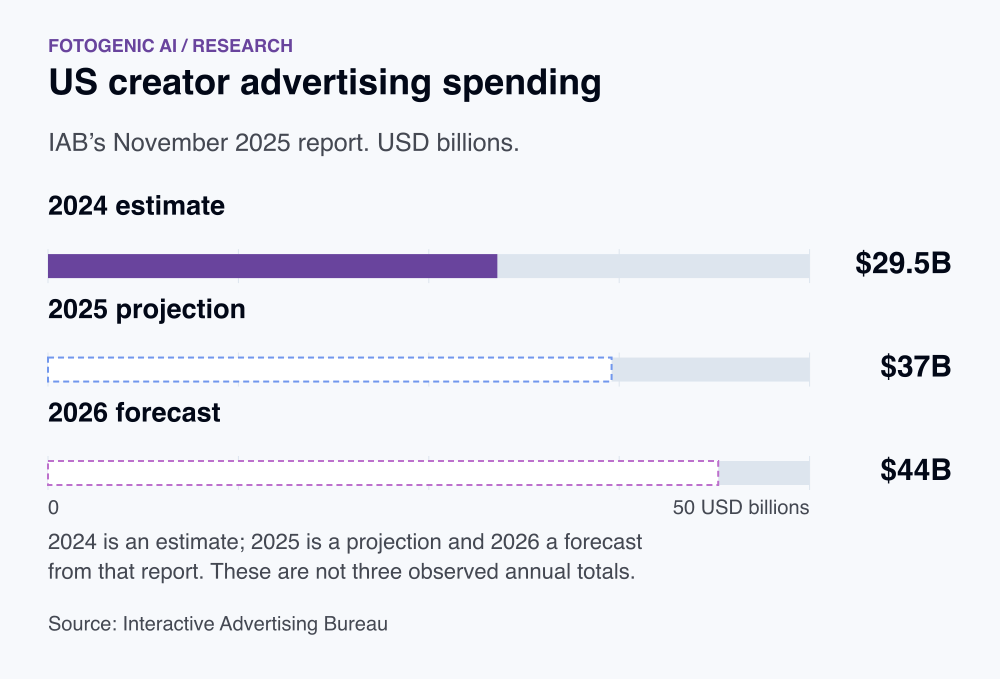
Separate creator advertising from the whole creator economy
Advertising spend covers payments associated with advertising activity. It does not capture every creator income stream, such as subscriptions, direct product sales or services. A forecast for creator advertising therefore should not be presented as the total value of the creator economy.
Define the garment and campaign requirements: prepare a fashion campaign brief.
Plan the content after the first post
Agree which assets the brand needs and where each can be used. A creator post, a product-page demonstration and a paid advertisement may require different framing, length and revisions. Keep those deliverables explicit before evaluating the proposed production cost.
Keep campaign deliverables consistent: plan product-photo ad creative.
Budget the asset and its licensed reuse separately
Creator content can be distributed as paid creative after the original post, but that use needs an agreed scope. Specify the assets, channels, duration, edits and amplification before comparing quotes. The reported creative-asset share is different from the share of advertising budget spent on creators.
Track production fees, licensed reuse and distribution costs separately from the creator's total income. A useful asset may support several placements, but repeated use does not make its production cost disappear or guarantee a return on paid spend.
Use campaign sets to specify coordinated brand assets separately from a creator’s distribution brief.
Distinguish sponsorship from a creator business
Creators can earn through brand work, paid memberships, subscriptions, merchandise and other direct sales. Patreon's cross-platform research describes interest in direct fan relationships, while advertising-spend reports count what brands buy. Neither is a worldwide count of people making a living from creation.
Define the creator population before using a count
Adobe’s historical creator definition includes monthly online creative sharing intended to grow a social presence. A creator population, full-time occupation and paid influencer market are different groups. Keep the 2022 estimate alongside its definition, then use the more recent income and payment research for livelihood questions.
Compare monetization routes on their own revenue base
Advertising shares, paid fan memberships, product sales and sponsor commissions create different receipts and obligations. Current platform terms help price a creator business, but they do not establish typical income or the size of the full creator economy.
For a merchant partnership, separate the content commission from the creator's own platform revenue. Agree the deliverable and licensed uses, then account for product supply, shipping, revisions, amplification and renewal rights. A creator's annual payment distribution is not a quote for your campaign.
| Revenue route | What is being paid for | Cost or restriction to check |
|---|---|---|
| Brand commission | Production, posting or licensed reuse | Deliverables, exclusivity, revisions and usage term |
| Platform advertising | Eligible monetized viewing | Applicable revenue base and program terms |
| Fan memberships or direct sales | An ongoing benefit or a defined digital product | Platform, processing and delivery costs |
FAQ
Questions about the research
The sources here do not establish one comparable total for every creator business. IAB projected US creator advertising at $37 billion in 2025 and $44 billion in 2026. That pool is separate from creator livelihood surveys and cumulative platform payouts. Keep the geography, period and included revenue streams attached to any market-size number.
Sources and method
- Interactive Advertising Bureau: 2025 Creator Economy Ad Spend & Strategy Report
iab.com
ReturnStudy details
November 2025; 2026 forecast
US intentional creator advertising. Excludes the full creator income economy.
- CreatorIQ and Influencers.club: The State of Creators 2026
creatoriq.com
ReturnStudy details
May 29-June 29, 2026
Survey of 5,095 creators across 100 regions. Self-reported earnings and experiences, enriched with platform data. Creator income is not advertising expenditure.
- YouTube: Made on YouTube 2025 updates
blog.youtube
ReturnStudy details
September 2025 announcement; preceding four years
Company-reported cumulative payments to creators, artists and media brands. Includes organizations; not annual individual-creator income or brand sponsorship spend.
- CreatorIQ: State of Creator Compensation
creatoriq.com
ReturnStudy details
2025 income and payments; 2026 publication
Survey of 300 creators in late 2025 plus a separate subset of flat payments processed through CreatorIQ. Platform payments exclude unobserved creator earnings and are not per-post rate cards.
- Adobe / The Harris Poll: Creators Toolkit 2026
news.adobe.com
ReturnStudy details
May 2026
16,000+ income-generating social creators across eight countries. Creative AI spans multiple media.
- CreatorIQ and Sapio Research: Creator-Powered Funnel
creatoriq.com
ReturnStudy details
May 2026 survey; June 10 release
100 US and UK brand/agency marketing leaders. Self-reported creative use and operational barriers, not a randomized performance comparison. Separate payment records for 38,100 creators and 59,600 campaigns are a different dataset. Not a representative small-merchant budget or creator rate card.
- Patreon and NewtonX: State of Create 2025
stateofcreate.co
ReturnStudy details
August 2024 fieldwork; February 2025 publication
US surveys of 1,007 creators and 2,002 fans across platforms/genres. Creator sample begins at 1,000 fans and is mainly 1K-100K, not a worldwide creator census. Platform use allows overlap; platform-specific question bases are not disclosed. Vendor-sponsored and self-reported, not observed sponsor returns.
- Adobe, with Edelman Data & Intelligence: Future of Creativity: Creators in the Creator Economy
news.adobe.com
ReturnStudy details
May 2022 survey; August 25, 2022 release
Publisher describes approximately 9,000 online creators across nine markets. Creator definition requires creative activity shared or promoted online at least monthly with an aim to grow social presence. The 303M figure is Adobe's historical population estimate, not respondents, full-time professionals or a verified 2026 count. The release separately lists general-population and Gen Z samples; do not add those cohorts and call the result a separate current population.
- YouTube Help: YouTube partner earnings overview
support.google.com
ReturnStudy details
Current partner terms checked October 19, 2026
Contractual revenue-share terms for eligible partners accepting the relevant modules. Watch Page: 55% of applicable net ad revenue. Shorts: 45% of the creator-pool allocation. Fan funding: 70% of specified net revenue. Different revenue bases; not payout per view, typical income or guaranteed earnings.
- Patreon Help Center: Creator fees overview
support.patreon.com
ReturnStudy details
September 11, 2026 page update; checked October 19, 2026
Standard platform fee of 10% for new creator pages published after August 4, 2025. Payment processing, payout, currency-conversion fees and applicable taxes are separate. Legacy terms differ. Membership and one-time sales terms describe platform economics, not observed creator take-home income or a creator-economy total.
How this report uses research
This report is an editorial synthesis by Fotogenic AI, updated on October 19, 2026. Source dates describe the underlying evidence. Survey responses, measured activity and forecasts are identified separately. Findings are not combined into a new market average. Multiple pages describing one study are treated as one evidence family.
Create with Fotogenic AI
Prepare the brand visuals around a creator campaign
Use Fotogenic AI to create supporting product scenes for the campaign's store and brand placements. Keep the creator's own account, endorsement and licensed content identifiable.