AI virtual try-on statistics
What virtual try-on can show. What the evidence says about its limits.
Virtual try-on covers appearance previews, while size recommendation and physical fit are separate tasks. Retailer adoption, visual-quality research and company outcomes below help define what a particular implementation can actually support.
Key takeaways
Separate shopper interest from deployment. DHL reported 77% openness to virtual try-on in its 2025 shopper survey and 36% business adoption of combined try-on or fit technology in 2026. [8][1]
Keep visualization and sizing evidence distinct. Zalando's reported reduction in size-related returns concerns size advice, rather than a standalone generated try-on image. [5]
Review the complete implementation behind a case result. Goodr's reported revenue-per-visitor gain combined AR try-on with a 3D viewer. [7]
Key facts at a glance
Shopper openness to virtual try-on
77%of shoppers were described as open to virtual try-on in DHL's 2025 report.
2025 survey interest, not current usage
DHL eCommerceApp-first shoppers wanting try-on or fit
50%of DHL's app-first shoppers wanted AI virtual try-on or fit features in future.
2026 app-first subgroup future interest
DHL eCommerceBusinesses offering try-on or fit technology
36%of surveyed ecommerce businesses reported offering virtual try-on or fit technology.
2026 business self-report; combined try-on/fit
DHL eCommerceFewer size-related returns with size advice
10%fewer size-related returns were reported for items with Zalando size advice.
Company size advice; year unspecified, not VTO
Zalando CorporateBeauty shoppers avoiding shade uncertainty
60%+of online beauty shoppers had avoided buying because of shade uncertainty.
Historical 2022 beauty shopper survey
GoogleRevenue per visitor in a combined AR and 3D case
59%higher revenue per visitor was reported for Goodr's combined AR try-on and 3D viewer implementation.
Mar-Aug 2022 combined AR/3D vendor case
Snap Inc.
Retailer adoption and visual quality
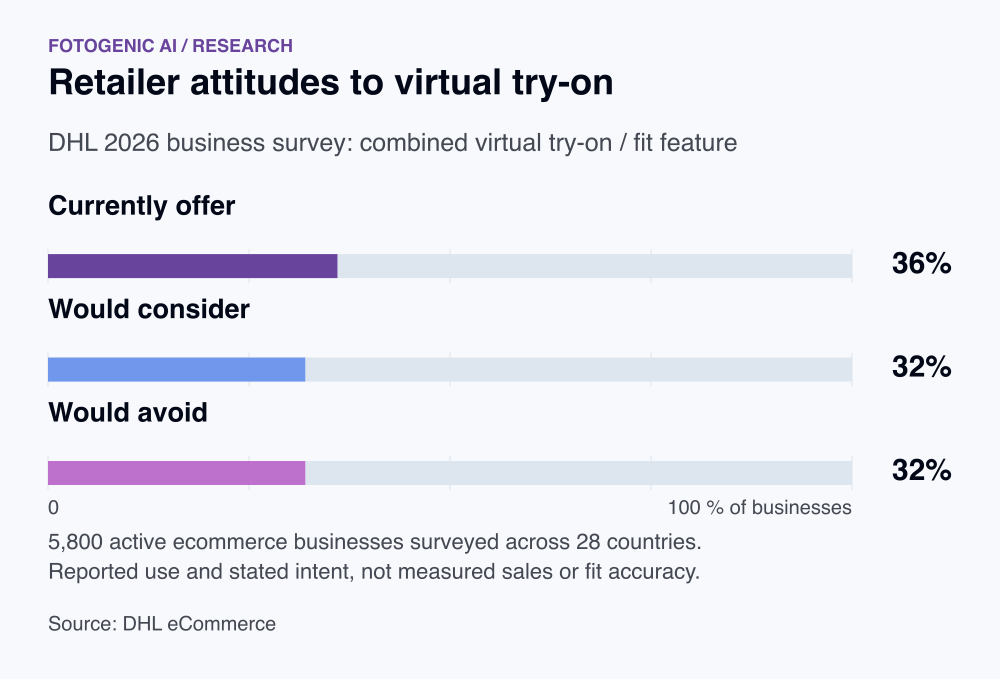
36% of surveyed ecommerce businesses reported offering virtual try-on or fit technology. [1]
Page 30, business responses. Combined try-on/fit category, not image-based apparel try-on alone and not an installation census.
32% would consider offering virtual try-on or fit technology. [1]
Same business survey and feature question; stated interest is separate from the 36% already offering it.
32% would avoid offering that combined try-on/fit feature. [1]
Same response distribution. Category suitability matters; the survey covers businesses beyond apparel.
62,688 generated try-on images formed the VTON-QBench quality dataset. [2]
Visual benchmark with synthetic augmentation; dataset size is not a commercial success or physical-fit accuracy measure.
14 try-on models were represented in that benchmark. [2]
Models were evaluated on visual quality. A convincing image does not establish how a garment fits a real body.
Shopping behavior and sizing evidence
60% more high-quality views were reported for Google virtual try-on imagery. [3]
Google’s 2024 engagement measure is not a conversion or return-rate improvement.
72% valued customer visuals for understanding size or sizing. [4]
The 2023 survey shows an information need, not an evaluation of try-on accuracy.
4 models per product were explored on average in Google’s virtual try-on experience. [3]
Model exploration is an engagement measure, not a number of sizes guaranteed to fit.
10% fewer size-related returns were reported for items with Zalando size advice. [5]
Company-reported relative reduction versus items without advice. Not a randomized modern generative try-on test, and not a ten-percentage-point reduction in all returns.
Beauty shade uncertainty
60%+ of online beauty shoppers had avoided buying because of shade uncertainty. [6]
A historical 2022 finding about beauty shopping, not apparel fit.
41% had returned a beauty item because the shade was wrong. [6]
This describes respondents who reported that behavior, not the share of all orders returned.
Eyewear implementation evidence
59% higher revenue per visitor was reported for Goodr's combined AR try-on and 3D viewer implementation. [7]
Snap internal data, March-August 2022. One eyewear merchant; no public sample, randomization or uncertainty. Not physical-fit accuracy or generative apparel evidence.
Shopper interest in virtual try-on
77% of shoppers were described as open to virtual try-on in DHL's 2025 report. [8]
Historical feature demand in a survey of 24,000 recent online shoppers across 24 countries. Multiple-choice interest, not actual use, fit accuracy or a 2026 adoption rate.
50% of DHL's app-first shoppers wanted AI virtual try-on or fit features in future. [1]
Page 42 of the 2026 report. Subgroup of shoppers who mainly use retailer or marketplace apps; subgroup sample size is not disclosed. Future interest in a combined try-on/fit category, not current use or an apparel-only survey.
Distinguish styling, shade and physical fit
Virtual try-on covers several different tasks. Showing how an outfit might look, helping compare a cosmetic shade and recommending a physical size require different evidence. A useful visual representation should not be described as a validated fit prediction simply because both experiences use the phrase try-on.
For merchant-created apparel imagery: inspect printed garments on a model.
Evaluate the difficult products
Review patterned garments, fine straps, layered outfits and products with visible logos or text. Check whether the representation preserves the actual item rather than generating a plausible substitute. For beauty, assess whether lighting and display conditions are explained appropriately for the task.
Review garment accuracy: direct an on-model product scene.
Use fit experiments for the promise they actually test
Gallino and Moreno’s randomized experiments found improved conversion and order value, with lower return-related fulfillment costs when fit information was available. The public abstract does not provide a numerical effect size. This is historical fit-information evidence, not a trial of generative clothing images. It should not be turned into a blanket returns-reduction claim for a new try-on tool.
Zalando’s size-advice account supplies a company-reported return outcome, with a weaker design than a randomized experiment. It concerns recommendations about size, not generated garment appearance. Keep those technologies and the relative-return denominator separate when deciding what your own experience promises.
Explore apparel product photography for garment imagery. On-model scenes do not supply a physical fit prediction.
Approve the experience in a defined sequence
Check product presentation, capability and the shopping journey separately. A visual pass alone cannot establish sizing.
| Stage | Check | Release decision |
|---|---|---|
| Product truth | Compare garment construction, text, pattern and variant with the source item. | Reject changes that misidentify the product. |
| Capability | Validate any size or shade promise against task-specific reference information. | Describe only the capability that was checked. |
| Shopping journey | Check image loading, controls, selected variant and an ordinary product-view fallback. | Keep the item understandable if the preview fails. |
| Commercial outcome | Compare eligible shoppers and follow purchases plus relevant returns over a complete window. | Report measured outcomes separately from visual quality. |
What can an eyewear result establish?
Goodr's historical case combines AR try-on and an interactive 3D viewer. Its reported commercial outcome is useful implementation context, but the release does not disclose how the comparison was constructed. It is not a controlled apparel-fit trial.
Choose the technology for the purchase question
Appearance preview, size recommendation and AR placement need different inputs and validation. Choose the capability first, then assess the relevant shopping outcome.
| Task | Inputs and capability | Outcome to evaluate |
|---|---|---|
| Garment appearance | Product and person images; preservation of garment and wearer detail | Useful inspection, purchases and item-mismatch returns |
| Physical size recommendation | Garment sizing and shopper measurements or validated fit inputs | Size-choice accuracy, size returns and home try-on costs |
| Eyewear or object placement | Category-specific AR geometry and camera tracking | Placement quality, interaction and purchases in that implementation |
Use printed garments as an acceptance test
For a printed garment, compare the source and output at the chest artwork, seams, neckline and hem. Reject substituted lettering, shifted artwork, altered construction or a changed color variant. Keep the original product view available if the preview fails.
A visual pass approves appearance only. Size advice needs its own reference measurements and evaluation. Record the rejected detail and revise the scene or retain the original photograph rather than publishing a plausible replacement garment.
FAQ
Questions about the research
Image-based virtual try-on visualizes appearance. Physical size accuracy requires garment measurements, a defined sizing method and its own validation. VTON-QBench assesses garment and person image quality; Zalando’s size-advice return result concerns a different sizing capability. Evaluate those tasks separately before choosing a merchant implementation.
Sources and method
- DHL eCommerce: 2026 E-Commerce Trends Report, full research and methodology
dhl.com
ReturnStudy details
Fieldwork December 2025-February 2026
29,000 recent online shoppers in 29 countries and 5,800 businesses in 28 countries; 1,000 shoppers per country. Grocery, tickets and flights excluded. Shopper and business responses are distinct. Cited findings appear on pages 5, 30 and 42; methodology is on page 78. The try-on/fit interest measure on page 42 concerns only the app-first shopper subgroup. Self-reported adoption, reasons and preferences do not establish transaction outcomes.
- ZOZO Research and Keio University: Reference-Free Image Quality Assessment for Virtual Try-On via Human Feedback
arxiv.org
ReturnStudy details
June 30, 2026 preprint revision
VTON-QBench: 62,688 generated try-on images from 14 models, 431,800 curated annotations by 13,838 qualified annotators. Includes synthetic garment-person augmentation. Evaluates visual garment/person fidelity, not physical size accuracy, customer conversions or return rates. Preprint findings are not an independently reproduced product comparison.
- Google: Virtual try-on expands to dresses
blog.google
ReturnStudy details
September 2024; August 2024 US engagement data
Google internal Shopping engagement research. High-quality views and model exploration are engagement measures, not fit accuracy, purchase conversion or return reduction. Public post does not disclose sample size.
- PowerReviews: Why shoppers value customer visuals
powerreviews.com
ReturnStudy details
December 2023; 2024 report
15,870 US consumers. Multiple-choice survey; 88% women, 55% millennials.
- Zalando Corporate: Technology and size advice
corporate.zalando.com
ReturnStudy details
Historical company results; page checked October 18, 2026
Company-reported sizing results versus items without size advice. Public article does not disclose observation window, sample or random assignment. Its July 2023 feature history is not a date for the effect estimate. Size recommendation is distinct from generative virtual try-on imagery.
- Google: AR beauty and shoe shopping
blog.google
ReturnStudy details
November 2022
Historical online beauty shopper findings and product announcement.
- Snap Inc.: Introducing AR Enterprise Services: historical merchant results
newsroom.snap.com
ReturnStudy details
Goodr internal data March 15-August 15, 2022; March 23, 2023 publication
Vendor-reported single-merchant eyewear case combining AR try-on and interactive 3D viewer. Public release does not disclose sample, comparison construction, randomization or uncertainty. Historical case, not a currently available service recommendation or generative apparel/physical-fit accuracy trial.
- DHL eCommerce: 2025 E-Commerce Trends Report: Shopper Edit
dhl.com
ReturnStudy details
Fieldwork February-March 2025; released June 4, 2025
Survey of 24,000 recent online shoppers across 24 countries, 1,000 per country. Page 46 lists virtual try-on in a multiple-choice feature-demand question; page 34 describes 77% of shoppers as open to virtual try-on. Stated demand does not measure actual use, physical-fit accuracy or purchase effects. The 2026 app-first subgroup has a different population and question, so the percentages do not form an adoption trend.
- Gallino and Moreno / INFORMS: The Value of Fit Information in Online Retail
pubsonline.informs.org
ReturnStudy details
Published May 2018
Randomized field experiments comparing availability of virtual fit information. Historical fit/size technology, not a test of modern generative garment imagery. The public abstract gives directions of effects, not numerical effect sizes.
How this report uses research
This report is an editorial synthesis by Fotogenic AI, updated on October 19, 2026. Source dates describe the underlying evidence. Survey responses, measured activity and forecasts are identified separately. Findings are not combined into a new market average. Multiple pages describing one study are treated as one evidence family.
Create with Fotogenic AI
Explore on-model garment presentation
Create on-model scenes in Fotogenic AI for apparel styling and campaign production, using your original garment photo to review product detail.